After a car accident in Dubai, arrange the required accident report and establish whether the vehicle can be moved safely before choosing a paint or body repair. The visible damage is only the starting point. A sensible collision-repair plan checks the affected structure, mechanical parts and safety systems, then explains what will be repaired, replaced and tested.
A police report, an insurance claim and a workshop estimate do different jobs. Keep them separate when making decisions. This guide takes you through reporting, inspection, approval and collection, with current repair-price examples and questions that help you understand the proposed work.
Report the accident and arrange safe recovery
For an emergency, call 999 and follow the responding authorities’ instructions. Dubai’s official driving and transport guidance also identifies the Dubai Police app as an accident-reporting channel. For a minor collision, follow the official reporting process and directions about moving the vehicles out of traffic.
Take photographs only when it is safe. Include the vehicles, registration plates, contact areas and wider location. Keep the report reference and the photographs for the insurer and workshop. These help explain the incident, but pictures cannot establish the condition of parts behind a bumper or prove that a car is safe to drive.
Do not continue driving with compromised steering or braking, fluid leaks, a tyre rubbing damaged bodywork, insecure panels, deployed airbags or an urgent vehicle warning. Arrange suitable recovery instead. If an electric or hybrid vehicle has impact damage near its battery or underside, tell the recovery provider and follow the manufacturer’s instructions. Do not touch damaged electrical components or attempt to make them safe yourself.
Confirm cover and approval before authorising repairs
The accident report documents the incident. It does not by itself confirm insurance cover or approve a workshop’s repair bill. Contact the insurer with the report reference before committing to insured work, and ask which repairer you can use.
Third-party liability cover does not cover collision damage to your own car under your own policy. Comprehensive cover may cover that damage, subject to the policy and claim decision. Agency repair, an approved repairer network, excess and possible parts-related contributions depend on the actual cover. Do not assume every garage is accepted or that the excess is your only payment.
Prepare the registration card, driving licence, policy or claim reference, accident report and any additional documents the insurer requests. Ask for written confirmation of the next step, including whether a survey or estimate approval is needed. If another party’s insurer is handling the damage, check its process before booking work.
- Confirm who will pay the workshop and which amounts you will pay separately.
- Ask whether dismantling for assessment needs prior approval.
- Agree how additional damage and revised estimates will be submitted.
- Confirm any recovery or replacement-car arrangements against your policy.
Registering a claim is not the same as authorising repairs. Keep the approval, the accepted estimate and later changes together so there is a clear record of the agreed scope.
Inspect beyond the visible dent or crack
Collision repairs can involve cosmetic, structural and mechanical work on the same vehicle. Cosmetic damage affects the finish or outer panel. Structural damage affects load-carrying body components. Mechanical damage can involve steering, suspension, cooling or other systems affected by the impact. A tidy exterior does not settle the other two questions.
An initial inspection should record the impact location, panel fit, warning messages and obvious leaks or wheel damage. The workshop may then need permission to remove covers or trim to inspect the area properly. Ask what this assessment costs and whether the vehicle will remain dismantled while approval or parts are pending.
| Impact area | Visible concern | What may also need checking |
|---|---|---|
| Front or rear bumper | Scuffs, cracks or uneven gaps | Mounts, reinforcement, adjoining components and sensors fitted in that area |
| Wheel or lower corner | Damaged wheel, tyre or arch | Steering and suspension components, clearances and relevant geometry measurements |
| Door, pillar or side panel | Dented skin or changed door fit | Hinges, latches, surrounding structure, seals and affected restraint components |

Ask for photographs of hidden findings and an explanation of why they change the plan. A damaged bracket, bent reinforcement or leaking component is more useful evidence than a general instruction to “replace everything”. Equally, the cheapest visible-panel repair should not exclude a necessary check simply because the exterior damage looks small.
Understand why parts are repaired or replaced
The decision depends on the component, material, damage and vehicle manufacturer’s repair instructions. It is not determined solely by the size of the dent or the age of the car. Ask the workshop to distinguish work that improves appearance from work needed to restore the affected component correctly.
Separate cosmetic methods from structural repair decisions
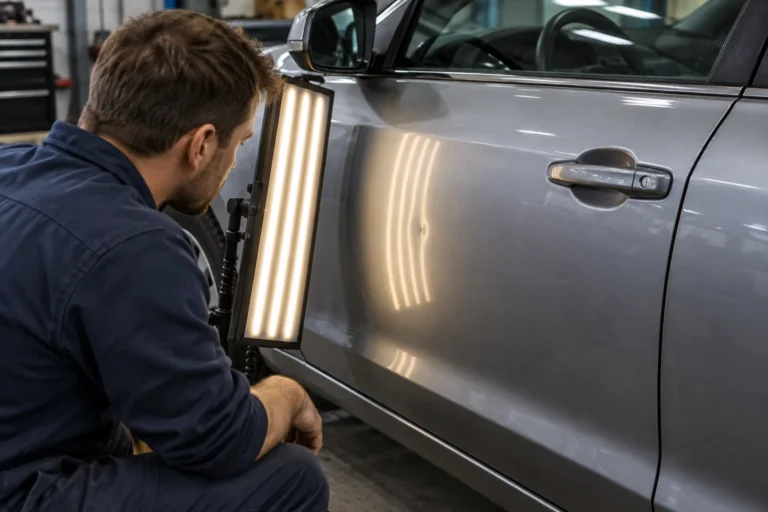
Some shallow marks can be corrected within the existing finish. A scratch through the paint needs a different approach. Paintless dent repair may suit an accessible dent with intact paint and suitable metal condition, but stretched material, sharp creases or repair restrictions can rule it out. Filling and repainting is not automatically a substitute for replacing an unsuitable panel.
A bumper cover may be repairable in one location and unsuitable for repair in another, especially where a sensor depends on the material or surface. Request the reason for repair or replacement and the proposed part specification. Genuine, aftermarket and used parts should not be treated as interchangeable without checking the vehicle requirements and the accepted repair plan.
Structural work needs the correct measurement and material-specific method. Some components can be repaired within defined limits, while others require replacement. Heating, pulling or cutting at an arbitrary location is not a universal solution. Ask which procedure supports the method and how the relevant dimensions will be verified afterwards.
A wheel-alignment adjustment also does not repair a bent suspension component. When a wheel has taken an impact, the damaged parts and their mounting areas need assessment before alignment results are interpreted. The final plan should identify the repairs and checks that address the cause, rather than merely removing a symptom.
Check restraints and distinguish scans from calibration
Airbags and seat belts require particular attention after a collision. The inspection and replacement requirements depend on the vehicle and impact. Deployed airbags require replacement, and the manufacturer may also specify work on pretensioners, sensors, control units or nearby components. Inspecting affected wiring and seat-belt mountings can be part of that process.
Clearing a restraint warning or describing an airbag as “reset” does not establish that the deployed components have been repaired. Ask for an itemised explanation of the required parts and procedures. Restraint work should be supported by the vehicle’s instructions, not a promise that the dashboard will look normal.
Request the checks required for your vehicle
A diagnostic scan reads electronic information and fault codes. Calibration sets or verifies the operation or positioning of a system using the prescribed procedure. They serve different purposes. A clean scan does not replace a required camera or radar calibration, and no warning light does not prove every affected system is correctly aligned.
Requirements can change with the model and work performed. Ford’s current ADAS repair guidance, for example, requires calibration after ADAS-related repairs even without a fault code. Use your own vehicle’s current procedures to establish what is needed, rather than applying one brand’s rule to every car.
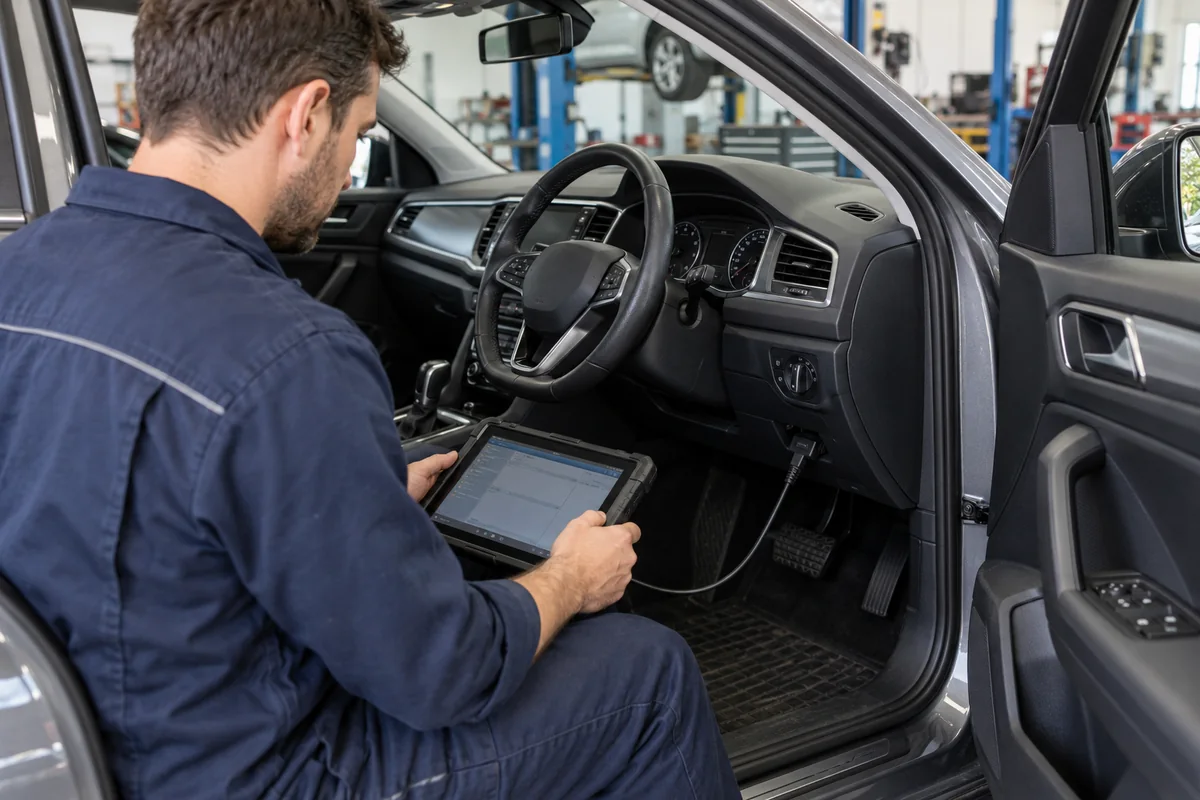
Confirm who performs the required work, whether it is included in the estimate and what report you will receive. If another facility handles calibration, ask how it fits into the repair sequence and collection date. A road test should not be used as a substitute for a prescribed calibration.
Agree the paint scope and finishing details
Collision repair does not automatically require a full respray. The estimate should identify the damaged panels and any adjacent panels needing colour blending. A paint code provides a starting specification, while shade comparison helps assess the match to the car’s existing finish.
For metallic or pearl finishes, appearance can change with lighting and viewing angle. Discuss the intended blending area and assess the completed finish in suitable light. An apparently close colour match under one workshop lamp is not the only consideration.

Finishing can also involve restoring corrosion protection, seam sealer and other materials disturbed during the repair. Their application must follow the relevant procedure. Ask how repaired joints and concealed areas will be protected, particularly when structural components have been replaced.
Where a sensor looks through a painted cover, the allowed materials and paint build matter as well as appearance. Ask the repairer to check the applicable restrictions. Get written aftercare instructions for washing, polishing, coatings or film. The waiting period depends on the paint system and repair process, so avoid relying on a universal number of weeks.
Compare repair prices with their actual scope
The following examples come from the workshop’s current collision-service prices. They are planning ranges for the described work, not a diagnosis from photographs or an insurance-approved total. Different repair options should not be added together as though every vehicle needs all of them.
| Work described | Planning price | Scope to confirm |
|---|---|---|
| Dent repair with paint | AED 440–1,450 | Damaged panel and required refinishing |
| Plastic bumper repair | AED 390–1,150 | Suitable dent or crack repair, preparation and painting |
| Aftermarket bumper replacement | AED 1,450–2,900 | New bumper supplied, fitted and painted where suitable for the vehicle |
| Major collision work | AED 2,450–11,750 | Multi-panel, structural or sensor-related work assessed individually |
These published ranges include 5% VAT. The major-repair range is not a maximum bill or a package covering every severe accident. Genuine components, specialised finishes, significant hidden damage and vehicle-specific procedures can change the total. A published aftermarket price does not override a manufacturer’s parts requirement.
For an isolated cosmetic dent, the separate guide to dent repair costs in Dubai explains the smaller repair choices. After a collision, establish the wider damage first rather than choosing a method from the lowest cosmetic price.
Make the written estimate easy to compare
Request the panel or component, quantity, part specification, labour, paint scope, applicable checks and VAT total. Confirm whether trims, clips, sensor work, scans, calibration and assessment charges are included or listed separately. A lower headline amount may describe a different scope.
If dismantling reveals more damage, ask for a revised estimate with photographs before additional work proceeds. For an insured repair, establish who obtains supplementary approval and which changes you must approve personally. This makes a revised bill understandable rather than an unexplained surprise at collection.
Plan the completion date around remaining work
A repair duration depends on assessment, approval, parts supply, bodywork, refinishing and final checks. The number of dented panels alone cannot predict the collection date. A small-looking impact can still involve an unavailable bracket or a required calibration.
Ask for the next milestone and the outstanding dependency. Has the estimate been approved, have the correct parts arrived, or is the vehicle waiting for final checks? Request an update when the scope changes. An expected date should be revised when those conditions change, rather than presented as a guaranteed turnaround for every accident.
Agree how you will be contacted and whether any storage or replacement-transport costs may apply. For an insurance claim, check those arrangements with the insurer as well as the workshop. Collect only after the agreed work and required checks are completed, with any unresolved item clearly explained.
Choose a repairer who explains the method
Start with the insurer’s repairer rules when using cover. Then ask how the workshop will assess your particular vehicle, access its repair procedures and complete the relevant structural, restraint and electronic work. A generic list of services is less useful than a clear answer about the proposed method.
- Ask for evidence of relevant current training or approvals when these are claimed.
- Confirm which work is performed onsite and which is subcontracted.
- Request an itemised estimate and an approval process for changes.
- Ask what measurements and repair records will be available.
- Read the written workmanship and parts warranty, including its exclusions.
Do not infer manufacturer approval from a logo or assume every repair carries the same warranty. Clear records and answers help you compare workshops, but they are not a universal guarantee of safety, resale value or future reliability.
Review the repaired car and keep records
At collection, compare the invoice with the approved estimate and any agreed additions. Ask the workshop to show the completed work and explain the final checks. If a required report is missing, ask for it before treating the repair as fully documented.
- Check panel gaps, door and bonnet operation, trim fit and the visible finish.
- Have affected lights, latches, seals and relevant vehicle functions demonstrated.
- Review structural measurements, alignment or calibration records where required.
- Ask what diagnostic findings were resolved and whether anything remains outstanding.
- Keep the report, approvals, parts details, invoice, warranty and aftercare instructions.
An exterior check cannot verify concealed joints or every safety system. That is why the repair method and supporting records matter. If a warning, leak, pulling, unusual noise or another new symptom appears after collection, contact the repairer promptly. Stop safely and arrange assistance if steering or braking is compromised.
Keep an accurate repair history for future maintenance and any later sale. Do not expect a repaint or a complete invoice to remove the accident from the vehicle’s history or guarantee its previous market value.
Common questions before approving collision repair work
Does a cracked bumper always need replacement?
No. Repairability depends on the damage, material, location and vehicle instructions. Sensor areas and damaged mounts can affect the decision. Ask why the proposed method is suitable rather than deciding from the crack’s length alone.
Can photographs give me a final repair price?
They can support an initial estimate, but concealed damage may require dismantling and inspection. Ask which assumptions remain and how additional work will be approved. Treat a photo estimate as provisional unless the full scope has been established.
Does the accident report mean insurance will pay?
No. The insurer must assess the claim against the cover and confirm the repair arrangements. Keep the report, but obtain the relevant approval before committing to insured work.
Is a clean diagnostic scan enough after repair?
Not when the vehicle requires calibration, physical inspection or another check. A scan and calibration serve different purposes. Ask which procedures apply to the affected systems and request the resulting records.
Will collision repairs restore the car’s resale value?
There is no guaranteed resale outcome. Buyers consider the accident history, damage, repair evidence and overall condition. Keep accurate records and describe the repair honestly when discussing the vehicle.
When can I apply paint protection film?
Follow written instructions for the actual paint system and repair process. Also check restrictions near driver-assistance sensors. A general waiting period cannot confirm that every newly painted panel or sensor area is suitable for film.
Need help understanding the repair scope?
Our accident and collision repair service can help you discuss the assessment and proposed work. Share the vehicle details, impact area and claim status so the team can explain the next step and prepare an appropriate estimate.