The best starter motor repair option depends on what has actually failed. A damaged cable or poor connection needs an electrical repair. A serviceable starter with an isolated internal fault may suit a targeted repair or rebuild. A badly damaged unit, or one without suitable repair parts, may need a correctly matched new or remanufactured replacement.
Start with diagnosis before buying a motor. Clicking, slow cranking and an occasional failure to start can also come from the battery or the circuit supplying the starter. This guide explains how to compare the findings, parts choices and fitted quotation for your car.
Understand what happens when you press start
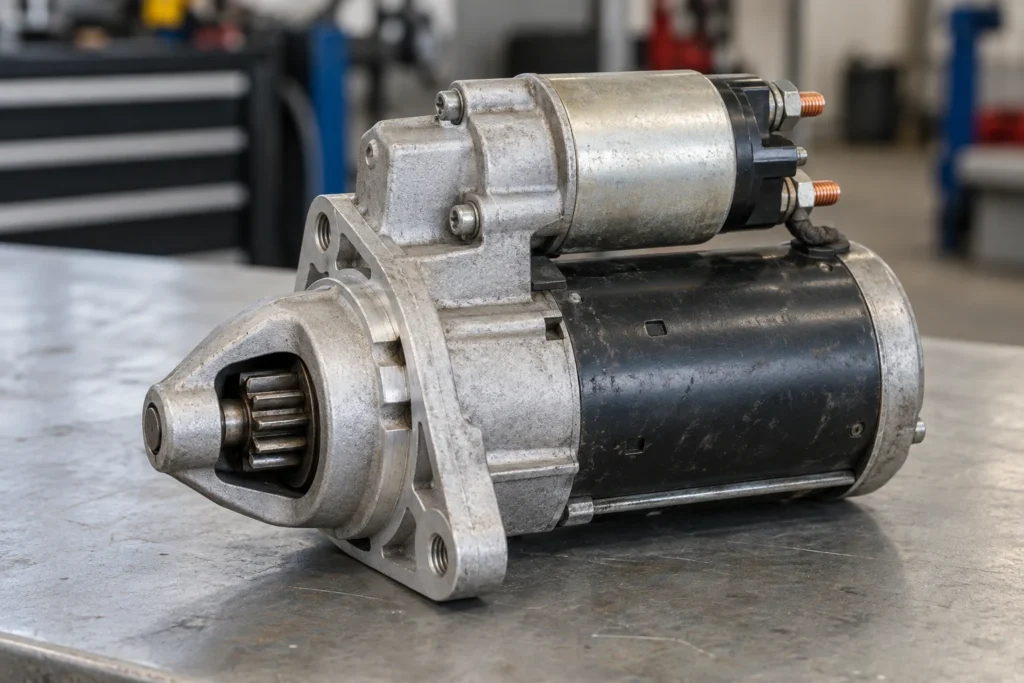
On a conventional combustion-engine starting system, the battery supplies an electric motor that turns the engine. The starter’s small pinion gear engages the larger ring gear on the flywheel or automatic transmission flexplate. The solenoid operates the engagement mechanism and switches the motor’s high-current supply.
The starter cranks the engine. It does not provide the spark or fuel that allows the engine to run. Once the engine starts, the starting mechanism should disengage. This distinction helps separate an engine that never turns from one that turns normally but will not fire.
Some hybrids and other vehicles use a motor-generator or a different starting arrangement. A pure electric vehicle does not need a conventional starter to crank a combustion engine. Identify the system fitted to your vehicle before accepting a repair recommendation.
Separate starter symptoms from other starting faults
Describe the sound and whether the engine actually rotates. Dashboard lights alone do not establish that the battery can deliver enough power for cranking. A single successful start also does not rule out an intermittent fault.
| What you notice | What needs checking | Useful next step |
|---|---|---|
| Clicks but does not crank | Battery condition, connections, supply cables and starter operation | Test the battery and starting circuit before condemning the motor |
| Engine turns unusually slowly | Battery output, circuit resistance, starter performance and mechanical engine resistance | Compare voltage, current and cranking behaviour with vehicle specifications |
| No crank and no useful response | Power supply and the start-control or authorisation circuit | Check the start request, relevant relay and safety interlocks |
| Starter whirs without turning the engine | Drive engagement, overrunning clutch and gear condition | Inspect the starter drive and engine ring gear |
| Grinding during a start attempt | Gear teeth, engagement and installation | Stop attempting starts and arrange inspection |
| Engine cranks normally but will not run | Engine-management, fuel, ignition or mechanical faults | Investigate the crank-no-start condition rather than assuming a starter replacement |
If the engine fires and then stops, the question is different again. Our guide to a car that shuts off after starting covers that separate symptom. Tell the workshop which stage fails so the assessment begins with the right system.
Make safe checks before arranging an inspection
Put the car in a safe location, apply the parking brake and follow the normal starting instructions. Note any key, immobiliser, battery or transmission message. Check that the automatic selector is in its required starting position, or that the clutch and brake pedals are operated as the manual requires.
Record whether the failure happens after the car has been parked overnight, after a hot drive, or intermittently. A short recording of an existing symptom can help, provided making it does not require further attempts when smoke, grinding or another warning is present.
- Do not bridge starter terminals or bypass a relay, immobiliser or park/neutral interlock.
- Do not hit the starter as a repair method or work underneath a car supported only by a jack.
- Keep hands and tools away from moving belts and fans, which may start unexpectedly.
- Do not attempt to boost a visibly damaged, leaking or swollen battery.
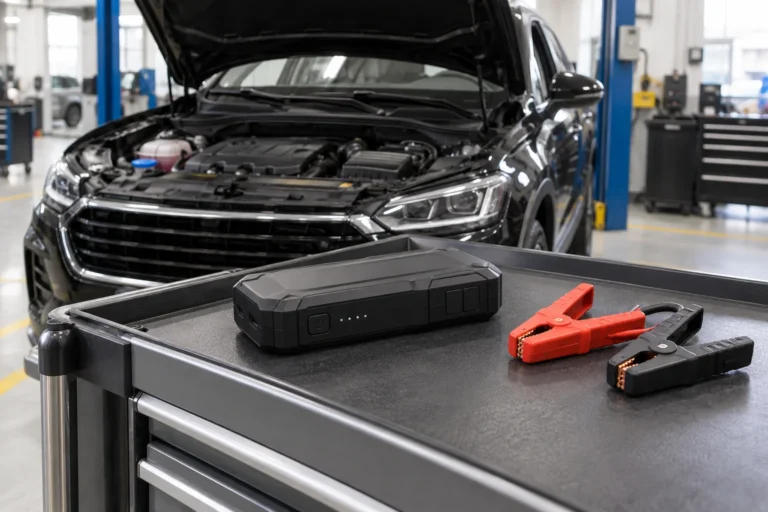
A jump-start is appropriate only when the vehicle and equipment instructions permit it. Use the approved connection points and compatible equipment. Read our safe car battery jump-start guide for that procedure. A successful boost is useful information, but does not by itself identify why the original start failed.
Ask which tests support the starter diagnosis
A useful diagnosis explains the fault and the evidence behind it. Ask for the findings in plain language rather than accepting “it clicks” as the entire reason for replacing a starter.
Confirm battery condition before testing the motor
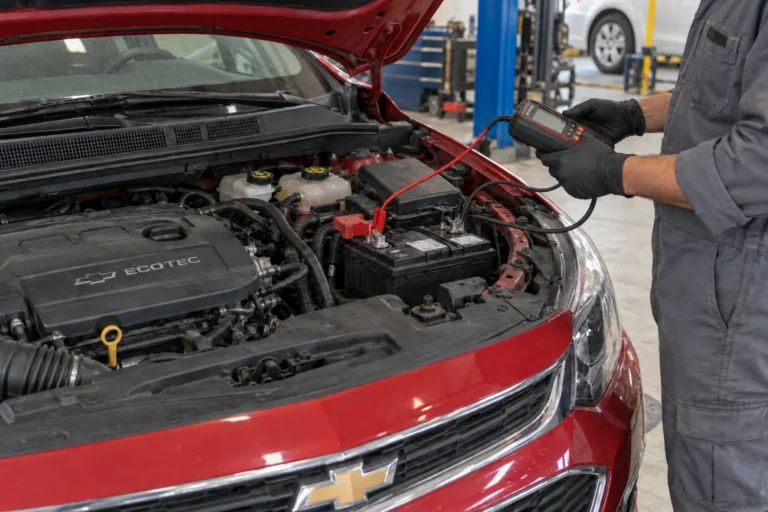
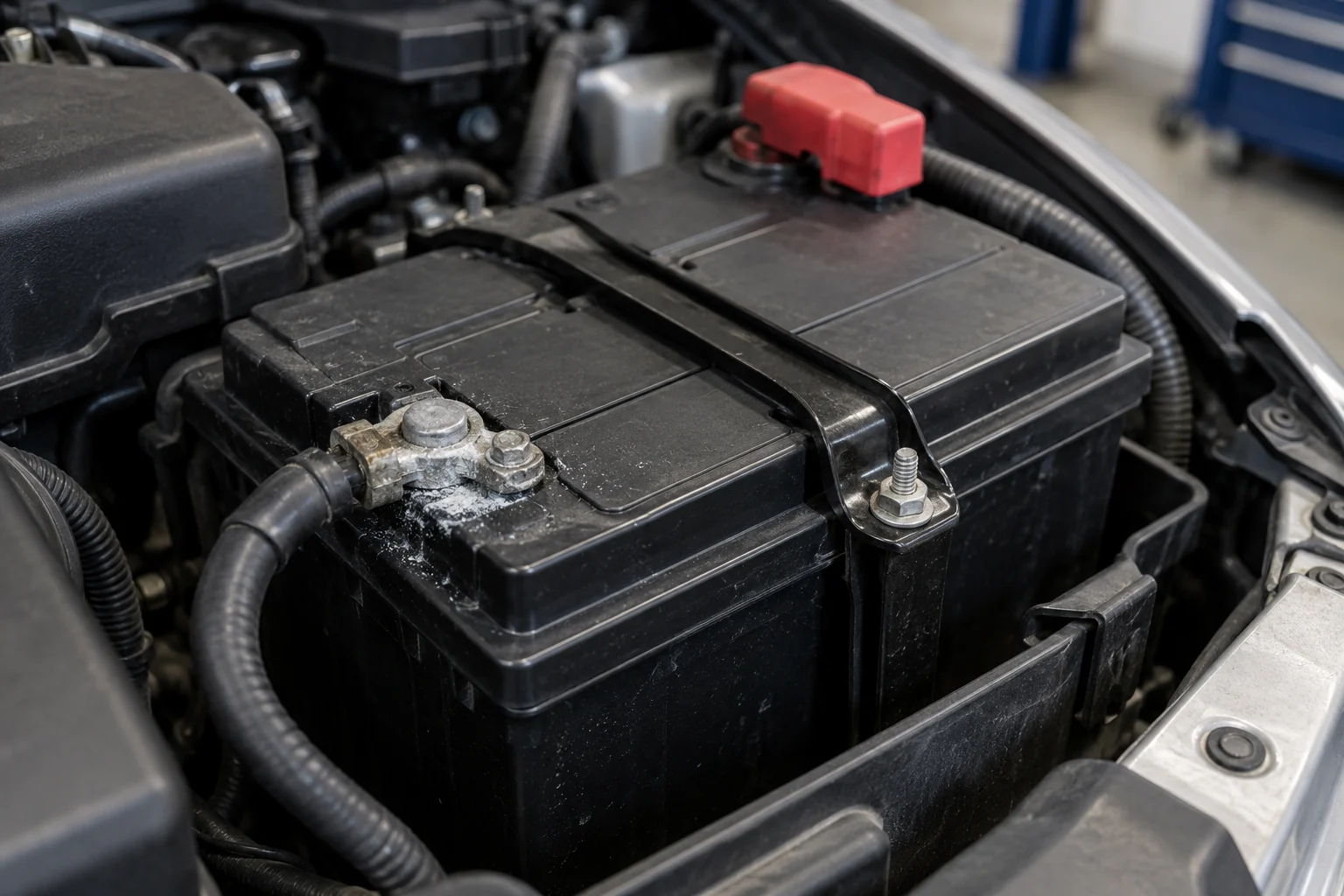
The workshop should establish battery condition and inspect the connections. A voltage reading while parked is only part of that assessment. A suitable battery test and the behaviour during a start attempt provide information about its ability to supply the required load.
If battery condition is the problem, discuss battery testing and replacement rather than buying a starter by default. If a battery repeatedly loses charge, the charging system or an electrical drain may also need investigation.
Check the supply and start-control circuits
Voltage-drop testing under load checks how much voltage is lost through the positive cable and ground path. A poor connection may behave differently when cranking than it does during a simple continuity check. The start-control circuit also needs checking when the motor does not receive the correct request.
A fuse, relay, switch, cable or interlock fault is a starting-system fault, but not necessarily an internal starter failure. The workshop should distinguish those findings. For help selecting someone to trace that circuit, see our guide to choosing a car electrician in Dubai.
Interpret starter current with the vehicle specifications
Current draw, voltage and cranking speed must be considered together. High current with slow rotation can point to starter trouble or mechanical resistance in the engine. Low cranking speed can also result from excessive resistance in the supply circuit.
There is no single pass or fail amperage for every petrol, diesel and stop-start vehicle. The limits must come from the relevant service information. DENSO’s starter troubleshooting guidance explains this relationship and why the battery and circuit checks come first.
Understand what a scan or bench test proves
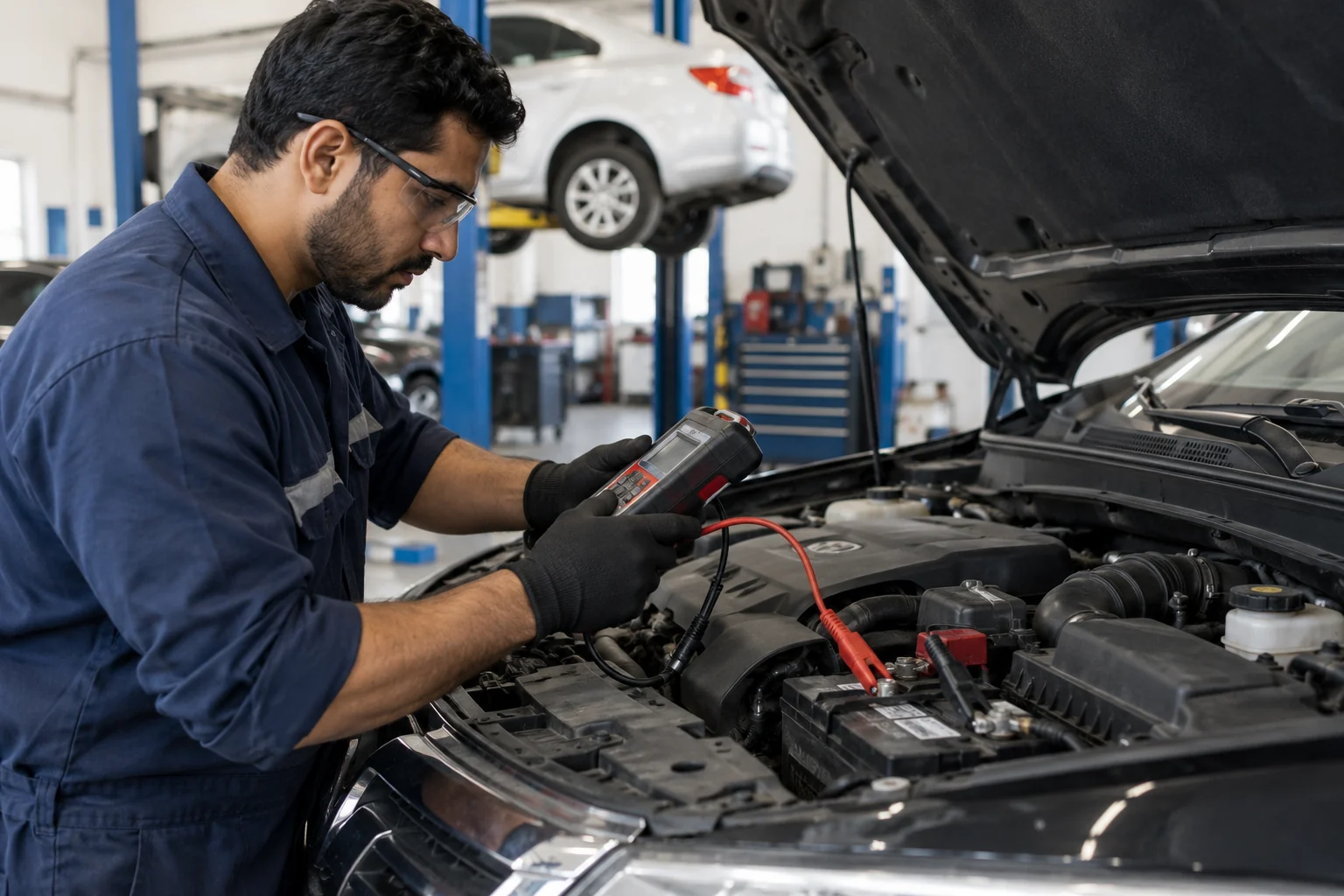
A diagnostic scan can help investigate start permission, relevant fault codes and system messages. A code does not automatically prove that the motor is defective, and an empty fault list does not establish that every cable and mechanical component is healthy.
Testing a removed starter can reveal an internal fault, but the result must be interpreted with the original vehicle checks. A motor that spins on a bench has not necessarily demonstrated reliable cranking under the vehicle’s load. Ask whether the test reproduces the reported failure and what checks remain after refitting.
Compare the available starter motor repair options
Once the fault is confirmed, compare the complete proposed job. The cheapest individual component is not always the cheapest fitted repair, especially when removing the starter requires substantial access work.
| Option | When it may suit | What to confirm |
|---|---|---|
| Repair the external circuit | The motor works but a cable, connection or control component fails testing | The measured fault and the checks confirming the repair |
| Targeted internal repair | A serviceable unit has an isolated fault and suitable repair parts are available | Exactly which component is replaced and the condition of the remainder |
| Rebuild the existing unit | The original assembly can be restored and properly tested | Inspection scope, parts replaced, test results and warranty terms |
| Remanufactured replacement | A correctly matched unit from an identified supplier is available | Part number, remanufacturing standard, warranty and any exchange deposit |
| New replacement | Damage, repair-parts availability or the overall quotation favours replacement | Manufacturer, exact specification and fitted price |
| Used replacement | A limited budget or scarce supply makes a used unit worth considering | Condition, return terms and who pays repeat removal labour if it fails |
When an isolated internal repair makes sense
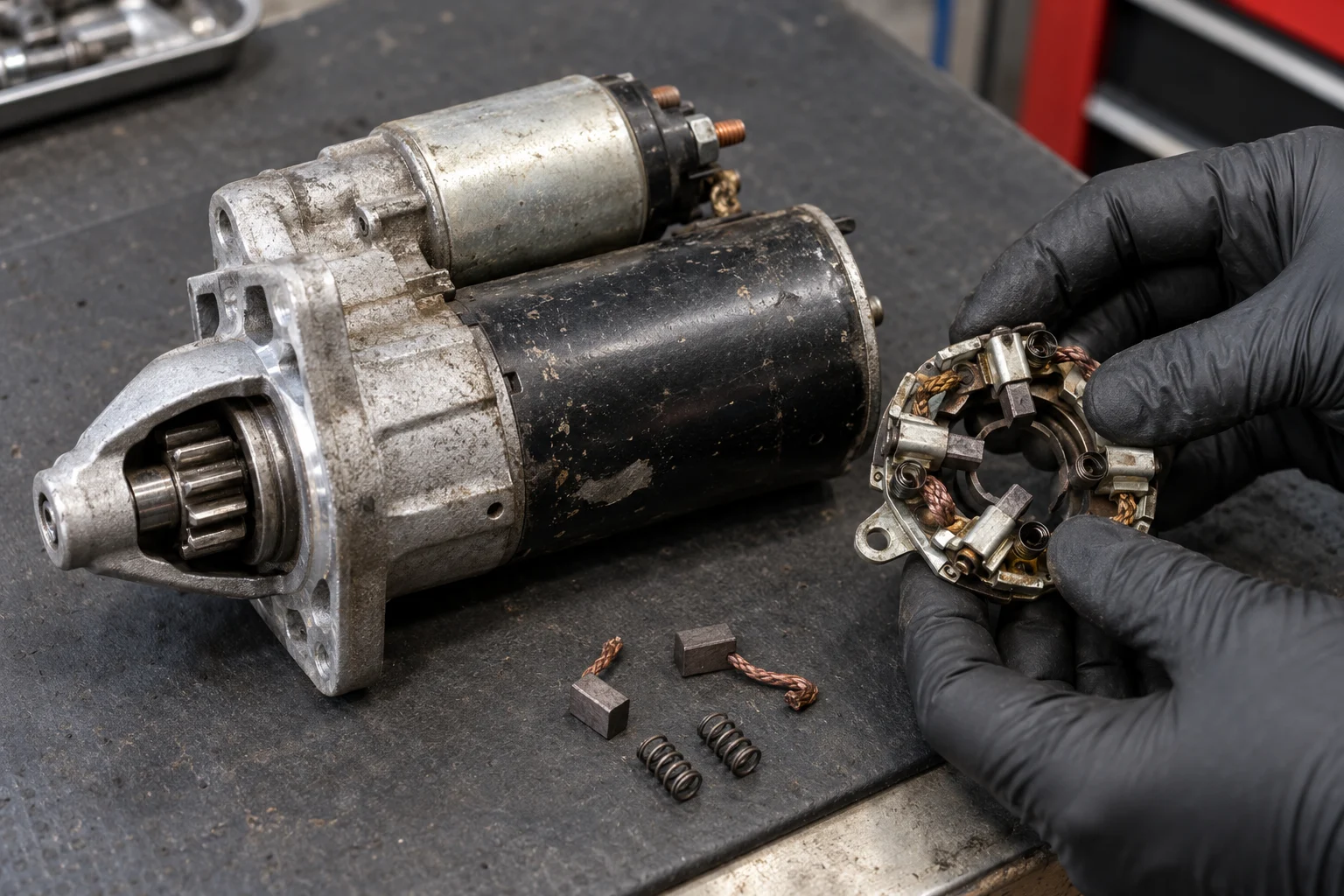
Depending on the design, a specialist may be able to replace a faulty solenoid or service worn internal components. Availability and repairability vary. Some suppliers recommend replacing the assembly for particular faults, so a repair should not be assumed possible for every unit.
Ask what the inspection found beyond the failed part. Replacing a brush holder is a different scope from evaluating the whole motor. A targeted repair is easier to assess when the quotation names the work and explains why the remaining assembly is suitable for reuse.
How rebuilding differs from buying a remanufactured unit
A rebuild usually means repairing your existing assembly. A remanufactured replacement is supplied as a restored unit, often through an exchange arrangement. These words are not interchangeable with a quick clean or a second-hand part.
DENSO describes remanufacturing as dismantling, inspecting and testing components, replacing unsuitable parts and testing the rebuilt assembly against the original standard. Its explanation of repair and remanufacturing helps clarify the distinction. Ask the proposed supplier what its own process includes rather than assuming every product meets the same standard.
When replacing the complete assembly is preferable
Replacement may be the practical choice when the inspection reveals extensive damage, appropriate internal parts are unavailable, or the total rebuild quotation offers little saving over a suitable replacement. Compare the warranty and repeat labour exposure as well as the initial amount.
A new part is not automatically a vehicle-manufacturer branded part. Ask for its maker and part number. With a used unit, request clear return terms and avoid treating an unknown service history as equivalent to a documented remanufacturing process.
Match the replacement to your exact vehicle
Provide the make, model, model year, engine and VIN when requesting a part match. Vehicles with similar badges can use different starting systems. A starter that looks close to the original may still be unsuitable.
- Confirm the specified starter part number and any approved supersession.
- Check the mounting arrangement, electrical connections and drive compatibility.
- Confirm the required starting-system voltage and output specification.
- Identify stop-start equipment or a motor-generator system before ordering.
Conventional starters can use direct-drive or gear-reduction designs. That describes how the motor drives the pinion, not a universal ranking of quality. A remote-start feature is a vehicle control function, not a separate motor type to choose for an ordinary replacement.
The installer should also check the engine ring gear where appropriate, especially after grinding or engagement trouble. New starter teeth will not correct damaged mating teeth. DENSO’s replacement guidance includes physical comparison of the units and ring-gear inspection.
Compare the complete starter repair quotation in Dubai
There is no verified fixed My Car Repair price for every starter repair in this guide. A loose connection, a starter rebuild and a new assembly are different jobs. Request a vehicle-specific quotation after the fault is identified.
Access can change the labour substantially. Ask what needs removing to reach the unit and whether the estimate includes putting those components back. Part availability, the chosen supplier and related gear or wiring damage also affect the total.
- Assessment fee. Identify the agreed tests, any removal needed for diagnosis and whether the fee is credited against approved work.
- Repair or part supplied. Name the failed component, repair scope or replacement manufacturer, condition and part number.
- Removal and installation. Include access work, refitting and the final starting checks.
- Related work. Separate any cable, ground, ring-gear or other repair from the starter price.
- VAT and logistics. Confirm whether VAT, recovery, delivery and any refundable exchange deposit are included.
- Warranty. Request the written parts and labour coverage, exclusions and procedure if the same fault returns.
The UAE standard VAT rate is 5%, according to the Ministry of Finance. Check how VAT applies to the actual quotation and invoice. Compare final payable totals for the same scope, rather than comparing a part-only price with a fitted repair.
Check the result before collecting your car
Ask the workshop to confirm that the original complaint has been addressed and explain the completed checks. If the problem occurred after a hot journey, testing only a cold start may not reproduce it. The return-to-service checks should suit the symptom and the repair.
Keep the invoice with the part details, work completed and warranty terms. Confirm that any identified supply or ground fault was repaired too. If the car had a charging warning, our guide to signs of a failing alternator explains that related investigation.
Afterwards, avoid prolonged repeated cranking and follow the manufacturer’s starting instructions. Report renewed slow cranking, grinding or engagement trouble promptly. There is no universal scheduled replacement mileage for every starter, and a warranty does not guarantee that a different starting-system fault cannot occur.
Common questions about starter repairs and replacement
Does a clicking sound mean I need a new starter?
No. Clicking can occur with battery or connection problems as well as starter faults. Battery and starting-circuit tests are needed before choosing a replacement.
Can a starter motor be repaired instead of replaced?
Sometimes. It depends on the fault, the condition of the assembly, whether it is serviceable and the availability of suitable parts. Compare the complete repair scope and fitted cost.
Will a jump-start fix a bad starter?
A boost can help with an inadequate battery supply when the vehicle instructions permit it. It cannot repair internal motor or gear damage. A successful boosted start still needs an explanation for the original failure.
Is a remanufactured starter the same as a used one?
No. Remanufacturing involves a defined restoration and testing process. A used unit may have no equivalent inspection or refurbishment. Confirm the supplier’s process and warranty rather than relying on the description alone.
How long will a starter repair take?
The diagnosis, access to the unit, repair method and parts availability determine the timing. Ask for an estimate after inspection and confirm whether specialist repair or an exchange part adds waiting time.
Can I keep driving with intermittent starting trouble?
The car may not restart after you switch it off. Arrange an inspection and avoid relying on another successful start. Smoke, burning smells, grinding or a starter that remains engaged require stopping and assistance.
Discuss a starting fault with our team
Tell My Car Repair your model, year and engine, what happens when you press start, and whether the fault occurs hot, cold or intermittently. The team can discuss the appropriate assessment and a quotation for any proposed work.