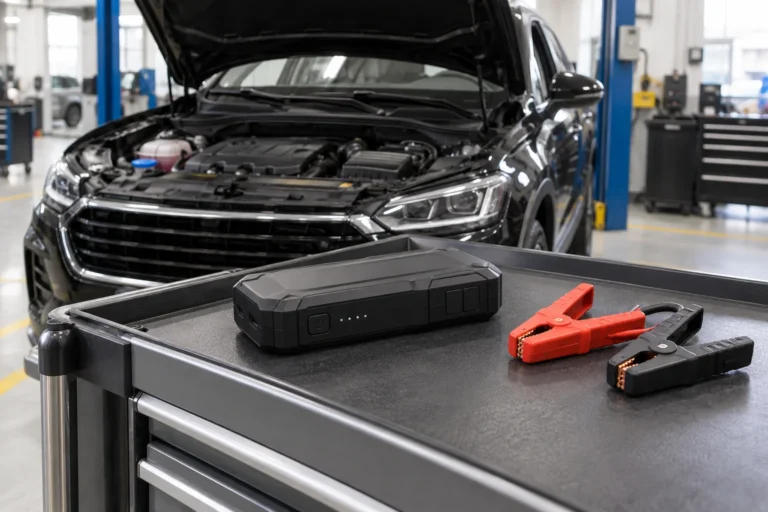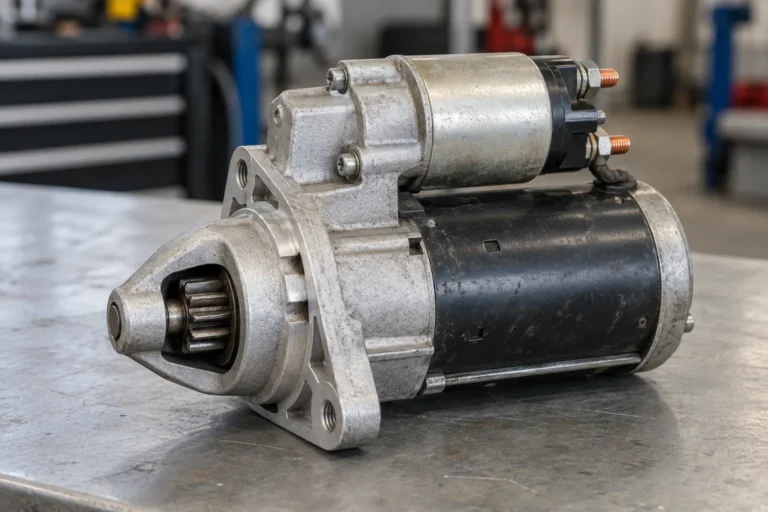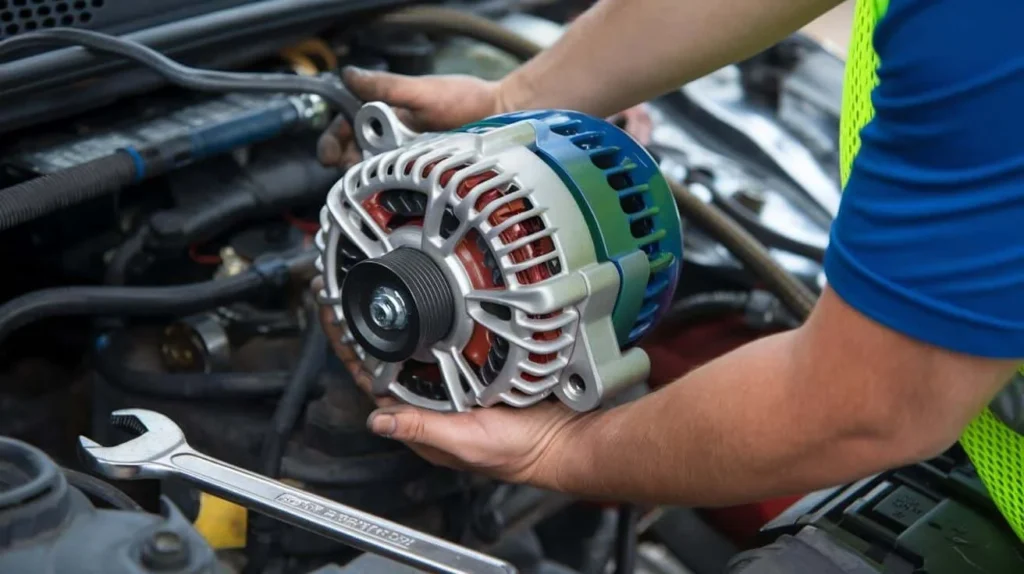
Signs of a failing alternator can include a charging warning while the engine is running, changing headlight brightness, repeated battery discharge, electrical glitches and noise near the belt drive. These symptoms deserve investigation, but none identifies the alternator as the failed part on its own. The battery, belt, connections and charging controls can cause similar problems.
If a charging warning appears while driving, move carefully to a safe stopping place and follow your owner’s manual. Smoke, a burning smell, overheating or a change in steering assistance makes stopping more urgent. Do not assume that the car has a predictable number of minutes or kilometres left.
Read the charging warning in its context
A battery-shaped warning usually concerns the charging system. It does not simply mean that the battery needs replacing. On many conventional cars, the lamp is visible with the ignition on and the engine stopped, then goes out after starting. Check your manual for the normal sequence and the meaning of any accompanying message.
A warning that stays on or returns with the engine running is different from that normal start-up check. Record the message when safely parked. If it appears after the engine has already stalled, it may reflect the stopped engine rather than establish what caused the stall.
Stop safely if charging warnings are accompanied by smoke, a hot electrical smell, overheating or impaired steering. Switch off when safely stopped, keep clear of smoke or fire and arrange appropriate assistance. Do not keep restarting to see whether the warning disappears.
A persistent charging warning also warrants prompt help when the car still seems to run normally. Switching off optional accessories does not repair the fault or establish a safe driving distance. Keep lights and other equipment needed for safe driving in use while reaching a safe stopping place.
Compare the symptoms before blaming the alternator
The combination and timing of symptoms help decide which checks come first. They remain clues, rather than a substitute for testing.
| What you notice | What needs separating |
|---|---|
| Charging warning while the engine runs | Alternator output, belt drive, wiring, regulator and charging-control faults. |
| Headlights flicker or several accessories behave unusually | Unstable supply, connections or control faults. A single faulty light or window may have its own circuit problem. |
| Slow cranking or clicking before starting | Battery condition, terminals, cables and starter operation. The alternator is not producing power before the engine turns. |
| Battery goes flat again after replacement | Charging performance, battery compatibility, parked current draw and how the vehicle is used. |
| Whining, grinding or squealing near the engine | Alternator bearings, belt, tensioner, pulley and other driven components. Sound location alone is inconclusive. |
Notice whether the symptoms occur after overnight parking, during a drive, at idle or after the engine warms up. Mention recent battery work, a jump-start, accessory installation or water exposure. These details can help a technician reproduce an intermittent fault.
Do not describe every warning as a low-voltage problem. An unstable electrical supply may generate several messages, but a brake, steering or engine warning still needs interpretation. A scan should preserve relevant fault information before codes are cleared.
Understand which alternator parts do different jobs
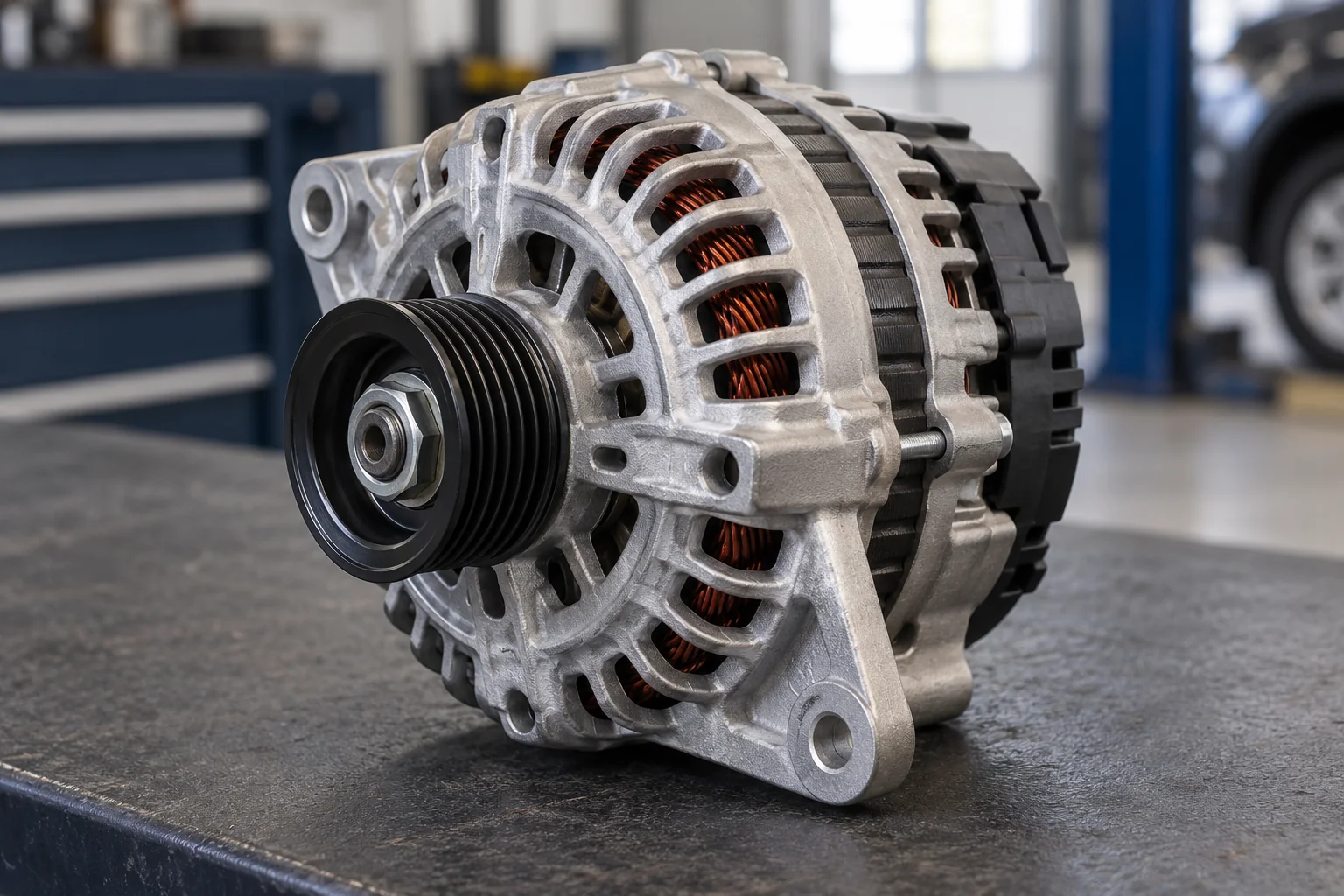
In a conventional engine-driven charging system, a belt turns the alternator. A rotor and stationary windings generate electrical energy, rectifier diodes convert it for the vehicle’s direct-current supply, and a regulator controls charging. The battery stores energy and supplies the high current needed for starting.
This explains why the component can fail mechanically or electrically. A bearing may become noisy, while a rectifier or winding fault may affect output. A regulator problem can cause incorrect charging even though the pulley still turns.
The alternator also depends on parts outside its housing. A slipping belt, poor earth connection or damaged output cable can interrupt charging without requiring replacement of the complete unit. That is why identifying the cause matters more than recognising the alternator’s appearance.
This guide concerns vehicles with an engine-driven alternator. Hybrid, electric and other electrified powertrains can use different charging arrangements. Their warning messages and test procedures must be matched to the actual vehicle.
Separate battery discharge from a charging fault
A flat battery describes a condition, not its cause. It may have lost usable capacity, received insufficient charge, supplied equipment while parked or been affected by a poor connection. An alternator fault is one possibility among these.
A jump-start can supply enough energy to start an engine without resolving the underlying problem. If the engine then stops, investigate the charging system alongside other possible causes of stalling. If it keeps running, that still does not prove that the battery is defective or that charging is normal under every condition.
Where the manual permits a jump-start, use the approved connection points and procedure for the vehicle. Repeated jump-starts should prompt testing rather than become the routine response to a battery that keeps going flat.
A complaint that mainly occurs after parking needs a different investigation from a charging warning during a journey. Testing for excess parked current draw must allow the car’s systems to shut down. Opening doors or waking modules can change the result, so pulling random fuses immediately after switch-off is not a reliable shortcut.
Gather useful observations without creating another fault
You can help the diagnosis without dismantling the alternator or running improvised tests. Safely parked observations are often more useful than a guess about which part to buy.
- Record the exact dashboard message and whether the engine was running when it appeared.
- Note which functions changed, how long the car had been parked and whether the symptoms return when warm.
- Provide the model, year and engine details, along with the battery specification if available.
- Mention recent repairs, reversed jump leads, water exposure or newly fitted electrical accessories.
- Photograph visible damage only where you can do so without reaching near moving parts or hot components.
Never disconnect a battery terminal with the engine running to test the alternator. This can create voltage spikes and damage electronics. Likewise, do not bridge a fuse, short terminals together or substitute a higher fuse rating.
The main hazards around a conventional low-voltage charging system include high current, short circuits, battery gases, hot surfaces and rotating machinery. Calling every alternator a high-voltage component confuses those risks with specialist high-voltage vehicle systems. Leave electrical connections and running-engine measurements to someone using the correct equipment and procedures.
Inspect the belt drive before replacing components
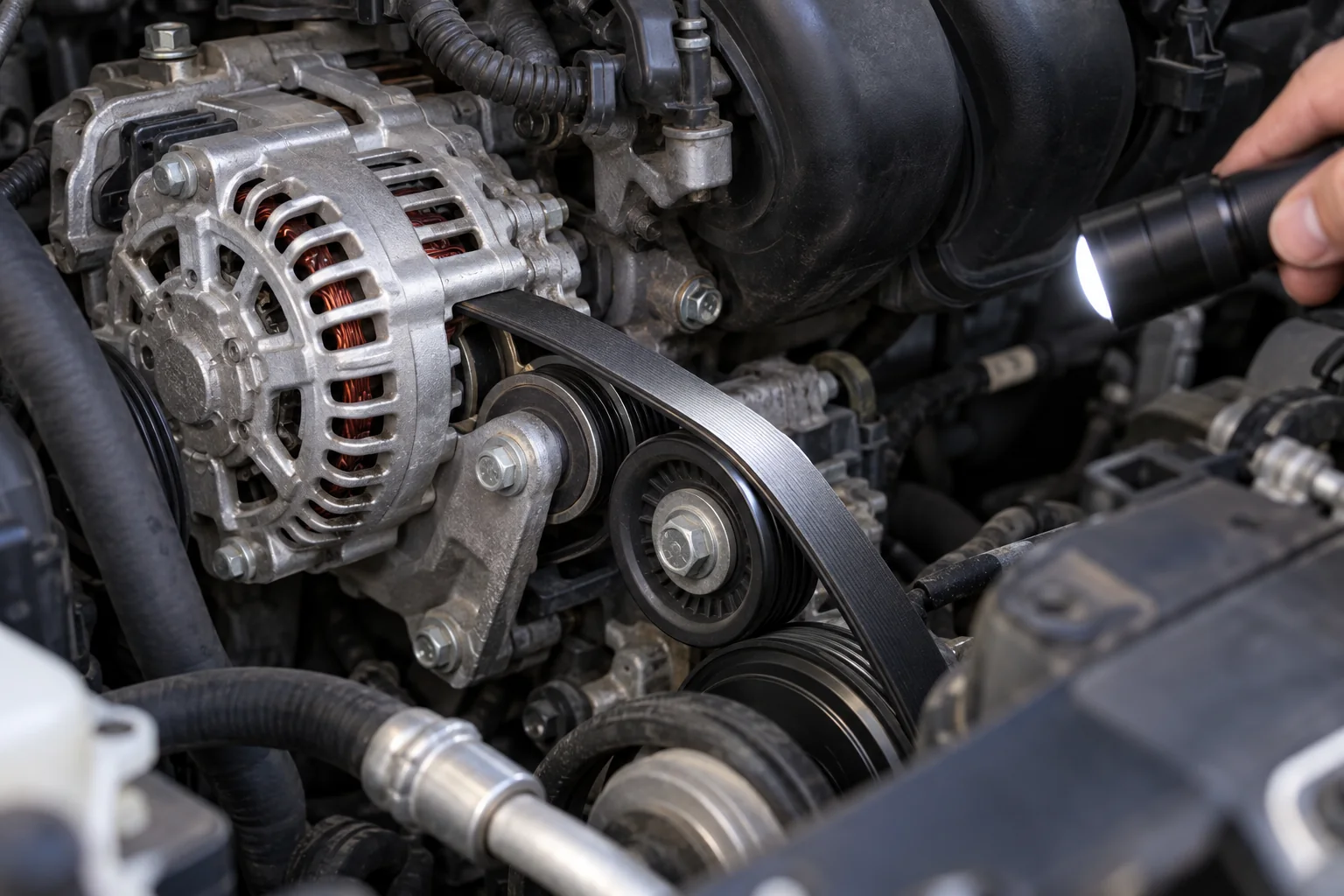
An alternator cannot generate its intended output if the drive system is not turning it correctly. A damaged or slipping belt can affect charging, and a defective tensioner or pulley can produce noise that sounds like an alternator bearing.
The workshop should assess belt condition, alignment and tension using the vehicle’s procedure. Increasing tension by guesswork can create bearing damage. A worn belt should not be treated with a spray as a substitute for establishing why it is slipping.
Ask whether the belt, tensioner or pulley needs work separately from the alternator. Some alternators use a freewheel or decoupling pulley, so the correct pulley type matters when choosing a replacement. Depending on the engine layout, the auxiliary drive may also serve other components.
If the belt is visibly missing, shredded or displaced, leave the engine off and arrange assessment. Do not run it to demonstrate the problem. A charging warning accompanied by a rising temperature needs urgent attention regardless of which components share the belt on that engine.
Test the complete charging circuit under suitable conditions
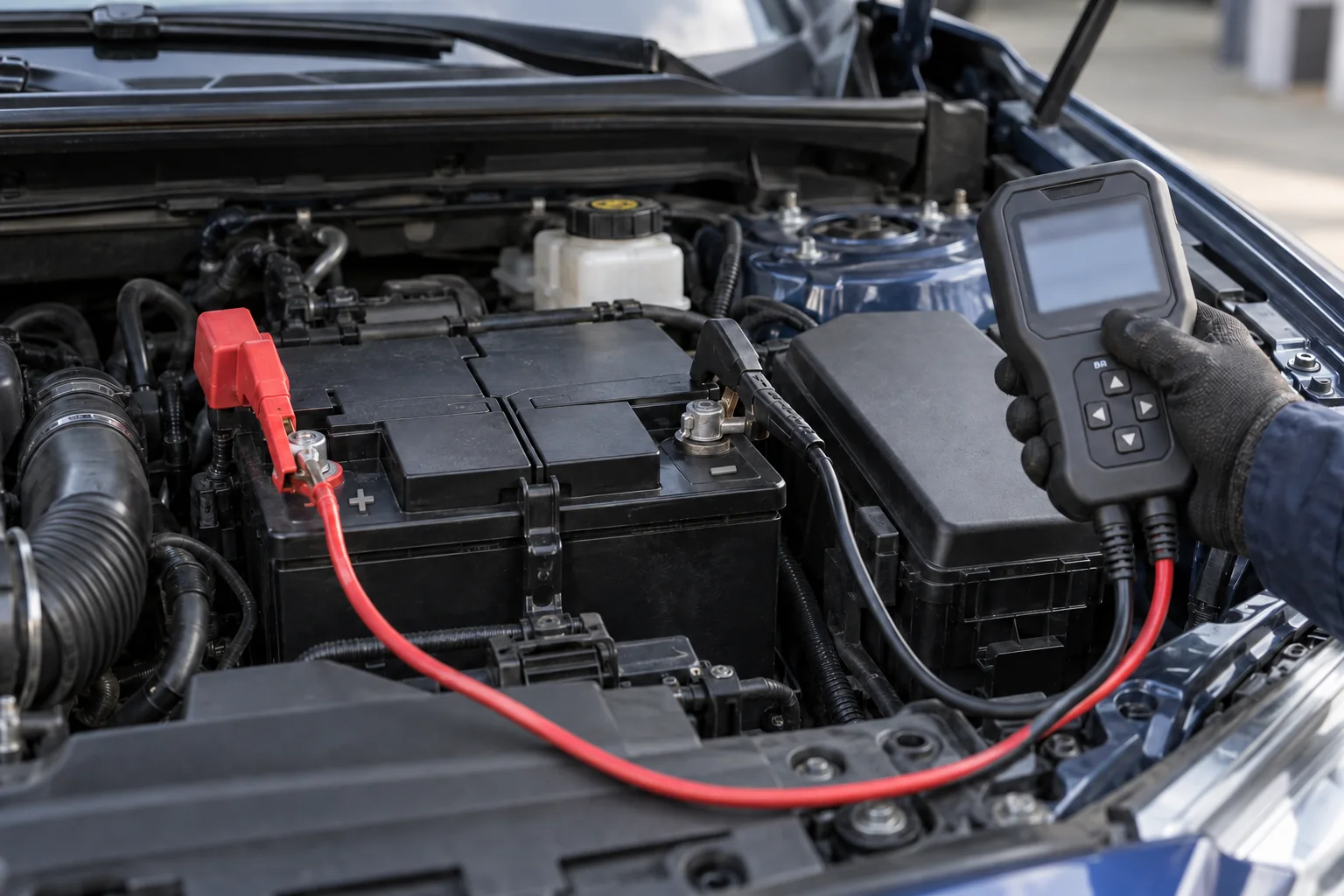
A charging system test should establish what is wrong before a part is ordered. Ask what was tested, under which conditions and how the findings support the proposed repair.
Check battery condition before interpreting charging results
The battery needs an appropriate condition test, with charging and retesting where necessary. A voltage reading alone cannot establish its usable capacity. The technician should account for battery type, charge level and the vehicle’s requirements.
The main connections also need assessment. A voltage-drop test measures electrical loss across cables and connections while current flows. This can reveal resistance that a clean-looking terminal does not exclude. The earth path matters as much as the positive supply.
Compare measured output with the vehicle requirements
Alternator voltage and current should be assessed using the manufacturer’s conditions and limits. Engine speed, electrical demand, battery state and temperature can affect the result. A charging test at one operating point may not reproduce a fault that appears only when warm or under load.
Where internal electrical trouble is suspected, waveform or ripple testing may help identify rectifier or winding faults. A bench test can provide further information where appropriate, but the vehicle’s wiring and control system still need consideration.
DENSO’s alternator diagnostic guidance recommends checking the battery, belt, wiring and voltage drops before replacing the unit. This supports a repair explanation based on findings rather than the warning lamp alone.
Allow for smart charging when reading voltage
Modern charging controls can deliberately vary alternator output. Some systems use a battery sensor and communication between the regulator and control modules to respond to charge level, temperature and driving conditions.
Consequently, a single dashboard, socket-meter or battery-voltage reading below a familiar internet range does not automatically prove failure. The measured value must be compared with what the system is commanding and what the manufacturer expects in that operating state.
HELLA’s explanation of alternator regulation describes battery sensing and LIN communication used in controlled charging systems. Where fitted, a communication or sensor fault can require investigation alongside the alternator itself.
A diagnostic scan can show relevant faults and operating data, but a code is not a replacement instruction. Ask whether the workshop compared actual readings with requested operation. This also helps explain why a generic battery tester’s pass or fail result may need further vehicle-specific checks.
Choose repairs according to the confirmed fault
A repair recommendation should identify the affected component. The car’s age alone does not determine whether an alternator should be repaired or replaced, and a repair is not automatically a temporary fix.
| Finding or option | What to clarify before approval |
|---|---|
| Fault in a cable, connection or belt drive | Which repair restores the circuit or drive, and whether the alternator itself passed testing. |
| Serviceable alternator with a repairable internal fault | Parts availability, permitted repair method, condition of the remaining unit and testing afterward. |
| Suitable remanufactured replacement | Supplier, scope of rebuilding and testing, compatibility, written warranty and any exchange requirement. |
| New replacement unit | Correct specification, supplier, availability, fitting scope and warranty terms. |
Remanufacturing normally involves a fuller dismantling, examination, rebuilding and testing process than replacing one defective part. The label still needs a named supplier and clear scope. A used alternator of unknown condition is a different purchase.
Before fitting another unit, address any external fault that contributed to the original problem. Replacing the alternator while leaving a poor connection, unsuitable battery or defective drive component can lead to an unresolved complaint or another failure.
Check replacement specifications and the written quotation
The replacement must match the vehicle’s required output, regulator and control compatibility, pulley specification, mounting points and electrical connections. A part that looks similar or fits the bracket may still be unsuitable.
Cost depends on the confirmed fault, the selected unit and access for removal. There is no reliable single price covering a connection repair, an internal rebuild and a new alternator for every vehicle. Compare quotations for the same work and part specification.
- Ask whether diagnosis is charged separately and what the initial testing includes.
- Identify whether the quoted unit is new, remanufactured or repaired, with its supplier and part reference.
- Confirm labour, required belt or pulley work, post-repair testing and VAT in the written total.
- Check any return requirement for the old unit, additional authorisation needed and expected parts availability.
- Read the warranty duration, coverage and exclusions. Do not assume every repair has identical protection.
A regulator repair may require substantial removal work on one vehicle and be more accessible on another. Ask for a comparison of the complete job, rather than choosing from the price of an individual component.
Confirm charging performance after the repair is completed
The checks after repair should reflect the original complaint. A warning that appeared when warm needs more than a brief cold start. Intermittent noise, belt-drive operation and electrical load should be assessed where relevant and safe.
Ask whether the battery was appropriately charged and retested, the connections and drive were checked, and the charging system was verified against vehicle specifications. If battery replacement was also required, confirm the correct type and any model-specific registration or reset procedure.
Record any warning or symptom that returns. If it affects safe control or is accompanied by burning, smoke or overheating, stop safely. Avoid repeated jump-starts or buying another battery before the unresolved cause is investigated.
Follow the vehicle’s maintenance schedule and act on changes in charging, noise or starting behaviour. There is no universal alternator replacement age or guaranteed interval. Dubai’s weather does not, by itself, establish which component has failed.
Answer common questions about alternator warning signs
Can I drive with a failing alternator?
Do not assume a safe distance or runtime. With a charging warning, move carefully to a safe stopping place and follow the manual. Smoke, burning, overheating or impaired steering requires urgent stopping and assistance.
Does the battery warning mean I need a new battery?
No. With the engine running, it usually indicates a charging-system problem. The alternator, belt, connections, regulator or controls may need assessment. Battery condition should be tested separately.
Can a bad alternator damage a good battery?
Incorrect charging can affect battery condition. Repeated undercharging and overcharging need investigation. Test the battery after addressing the charging fault rather than automatically replacing both components.
Does a successful jump-start prove the alternator works?
No. Starting and continuing to run does not establish correct charging in every condition. A jump-start supplies starting energy, while the underlying battery or charging problem can remain.
What voltage should a working alternator produce?
Use the vehicle maker’s specified test conditions and limits. Smart charging can vary output, so a single generic voltage range is not a reliable verdict for every car.
Should I disconnect the battery to test it?
Never disconnect a terminal while the engine runs as an alternator test. Voltage spikes can damage electronics. Use proper electrical measurements and the vehicle’s service procedures.
Is alternator repair always cheaper than replacement?
No. Access, the failed part, remaining condition, available replacements and testing determine the total. Compare the complete scope and written warranty for a repair, suitable remanufactured unit and new replacement.
Why is the warning still on after replacement?
A connection, belt, control fault or incompatible part may remain, or the original diagnosis may need revisiting. Return with the warning details and ask for charging-system verification rather than another part replacement by guesswork.
Discuss charging problems with our Al Quoz team
Tell us your model, year and the warning or starting problem you have noticed. Ask about charging-system checks, the initial testing charge and suitable repair options. If the car cannot be driven safely, discuss transport before setting off.