A gasoline smell inside your car can come from spilled petrol, a filler seal, a fuel-vapour system fault or a liquid fuel leak. You cannot tell which one is present by smell alone. If the smell is strong, persistent or accompanied by visible leakage, stop safely, switch off the engine and arrange assistance. Do not restart a vehicle with a suspected fuel leak.
The useful question is where the fuel or vapour is escaping and how it reaches the cabin. This guide explains the possible sources, what information helps a workshop investigate them and why opening a window, changing a cabin filter or adding a fuel cleaner does not establish that the car is safe.
What to do when you notice petrol fumes
If you are driving, concentrate on reaching a safe stopping place rather than inspecting the car in traffic. Once stopped, turn off the engine and move occupants to a safe place away from traffic and the fumes. Avoid smoking, naked flames and any attempt to create a spark near the vehicle.
If fuel appears to be leaking, do not start the car to move it, listen for a hiss or reproduce the smell. Contact roadside assistance and describe the suspected fuel leak before transport is arranged. The recovery operator needs to know about the hazard, not just that the vehicle requires a tow.
Ford’s fuel-leak guidance advises against starting or driving a vehicle when a leak is suspected. That is a more useful starting point than treating every petrol smell as a loose cap.
If there are flames or you suspect an active fire, keep away and call Civil Defence on 997 in the UAE. Do not open a bonnet if fire may be underneath it. For an ambulance, call 998. For an immediate traffic danger requiring police assistance, call 999. A workshop booking is not a substitute for emergency help.
Possible sources of a gasoline smell
A workshop should distinguish a liquid fuel leak from a fuel-vapour leak and from an exhaust-related smell. More than one problem can be present. The location and timing help choose the inspection, but they do not prove which part has failed.
| Possible source | Useful context | What needs confirming |
|---|---|---|
| Spillage during refuelling | The smell began at the filling station | Whether residue is external or fuel has contaminated an interior surface |
| Filler cap, seal or filler assembly | The smell is noticed near the filler area | The actual closure design and condition of its sealing surfaces |
| Fuel lines or their connections | Odour, wetness or a recent fuel-system repair | The precise leak point and the correct repair for that fuel system |
| Fuel-pump module or tank sealing | A smell near the rear of the car or after tank work | The module, sealing ring, fittings and accessible tank area |
| Evaporative-emissions equipment | Odour after parking or refuelling, possibly with a warning | Vapour containment, hoses and valve operation |
| Fuel-rich running or exhaust entry | A different exhaust smell, rough running or a cabin complaint | Engine operation and where fumes can enter the cabin |
Do not use this table to select a replacement part. For example, a smell near the rear of the car does not automatically mean the pump itself has failed. A sealing or connection problem is different from a pump that cannot deliver the correct fuel supply.
Why the smell can appear after refuelling
Refuelling can leave petrol on the filler area, clothing or an item placed in the car. A spill should be reported to the filling-station staff and handled safely. Do not assume that an odour will disappear within a set number of minutes, especially if it persists inside the cabin or returns on later journeys.
The filler closure is another area to inspect. Some vehicles use a threaded cap and others use a capless system. Follow the owner’s instructions for your particular design. A cap that looks closed is not proof that the seal is sound, and a capless filler should not be prodded with improvised tools.
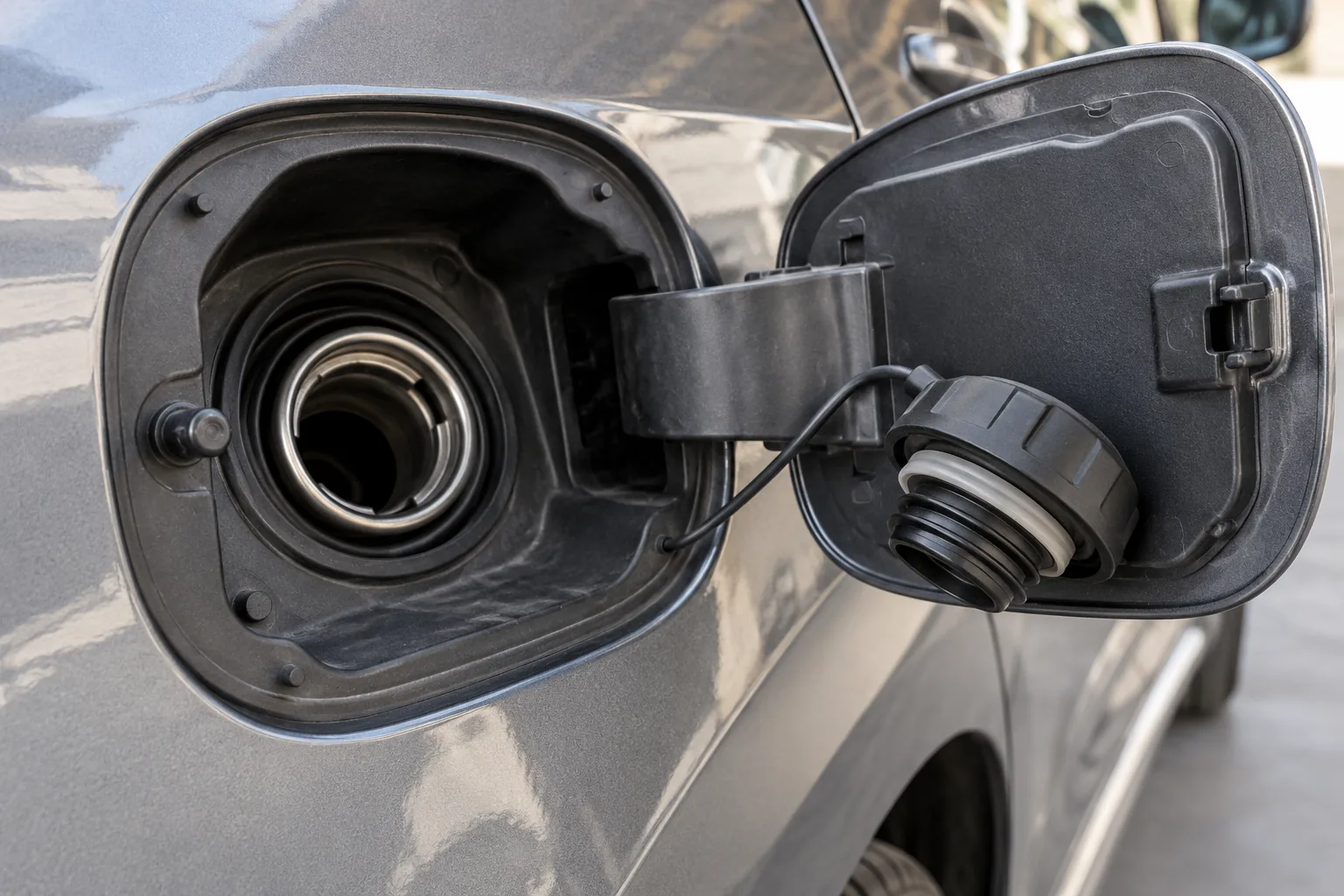
Repeatedly topping off after the pump has stopped can create spillage or affect vapour-handling equipment on some vehicles. Follow the vehicle and pump instructions instead of trying to squeeze more fuel into the tank. If the smell appears whenever the tank is full, tell the technician that pattern rather than reducing the fuel level as a workaround.
A petrol smell after recent tank, pump, injector or line work deserves particular attention. Send the invoice or describe what was removed. The technician can check the disturbed area without assuming that a new part has solved every sealing issue.
Fuel vapour and the EVAP system
EVAP means evaporative emissions. On many petrol vehicles, the system contains tank vapour, stores it in a charcoal canister and releases it to the engine under controlled conditions. Hoses, seals and purge or vent components can therefore be relevant to an odour complaint.
The exact arrangement varies by model. A damaged hose and a valve that does not operate correctly require different checks. A canister should not be replaced simply because EVAP is mentioned in a scan report. The inspection needs to establish what leaks or fails to function.
Vapour is not a reason to dismiss the smell as harmless. A driver cannot reliably establish that the complaint involves only an emissions fault rather than a liquid leak. Follow the suspected-leak precautions until the source has been assessed.
Fuel-pump seals and injector-area leaks
The pump assembly, its connections and its sealing to the tank are separate inspection points. Depending on the car, access can be through a service opening or require additional dismantling. A smell inside the car does not mean fuel must be visibly leaking onto the passenger floor.

At the engine, the fuel lines, connections, rail and injector area may need inspection. An external leak is different from an injector delivering the wrong amount into a cylinder. A recommendation should explain which condition was found rather than grouping both under “bad injectors”.
Do not disconnect a fuel line, remove a pump access cover or try tightening fittings to stop the smell. Petrol systems can retain pressure after shutdown, and direct-injection equipment requires the correct service procedure. These are workshop checks, not safe roadside experiments.
Why petrol smells may come through the vents
The ventilation system can bring an external odour into the cabin when fresh air is selected. That does not establish an air-conditioning fault. Describe whether you first noticed the smell with the fan on, after parking or near another source of fumes, but do not run the car again to test different settings if a leak is suspected.
A cabin filter is not a repair for escaping petrol. Fragrance, ozone treatment or switching to recirculation can change what you notice without correcting the source. The first job is to investigate the fuel or exhaust concern, followed by cleaning an affected interior only where appropriate.
Exhaust fumes are also a separate safety concern. A fuel-like description may be imprecise, and a technician should check the actual complaint rather than assuming every smell is raw petrol. Do not continue driving with fumes entering the cabin just because there is no visible fuel puddle.
No warning light does not rule out a leak
A dashboard warning and diagnostic information can guide an investigation, but they are not a leak detector for every physical connection. A petrol smell needs attention even when the engine runs normally and the check-engine light remains off.
Equally, an emissions fault code does not identify every failed part or prove that continued driving is safe. Stored codes, available vehicle data and physical inspection should be considered together. Avoid clearing the codes before the workshop has recorded them, particularly if the problem comes and goes.
Hard starting, rough running or a change in fuel use are useful accompanying observations. They are not proof of a faulty regulator, injector or engine control unit. Replacing an ECU because the car smells of petrol is a large leap unless targeted testing supports that conclusion.
Information to record from a safe place
Tell the workshop the make, model, year and when the smell began. Explain whether it followed refuelling, an impact, servicing or a repair. State whether the smell was noticed inside, outside or both and whether the tank had recently been filled.
Include any warning that was already displayed and whether there was visible leakage before you moved away. Take a photograph only if it can be done without approaching the hazard or traffic. Do not touch, taste or deliberately smell a puddle to identify it.
Tell the recovery provider if the car is in an enclosed parking area, cannot roll or has limited access. Our car recovery service can discuss the transport arrangements once the hazard and location are understood. Keep people away from fumes while waiting.
How a workshop investigates the cause
The first step is an agreed inspection with the safety concern stated clearly. Depending on the findings, the technician may inspect accessible fuel components, record relevant diagnostic information and select further tests using the manufacturer’s service data.
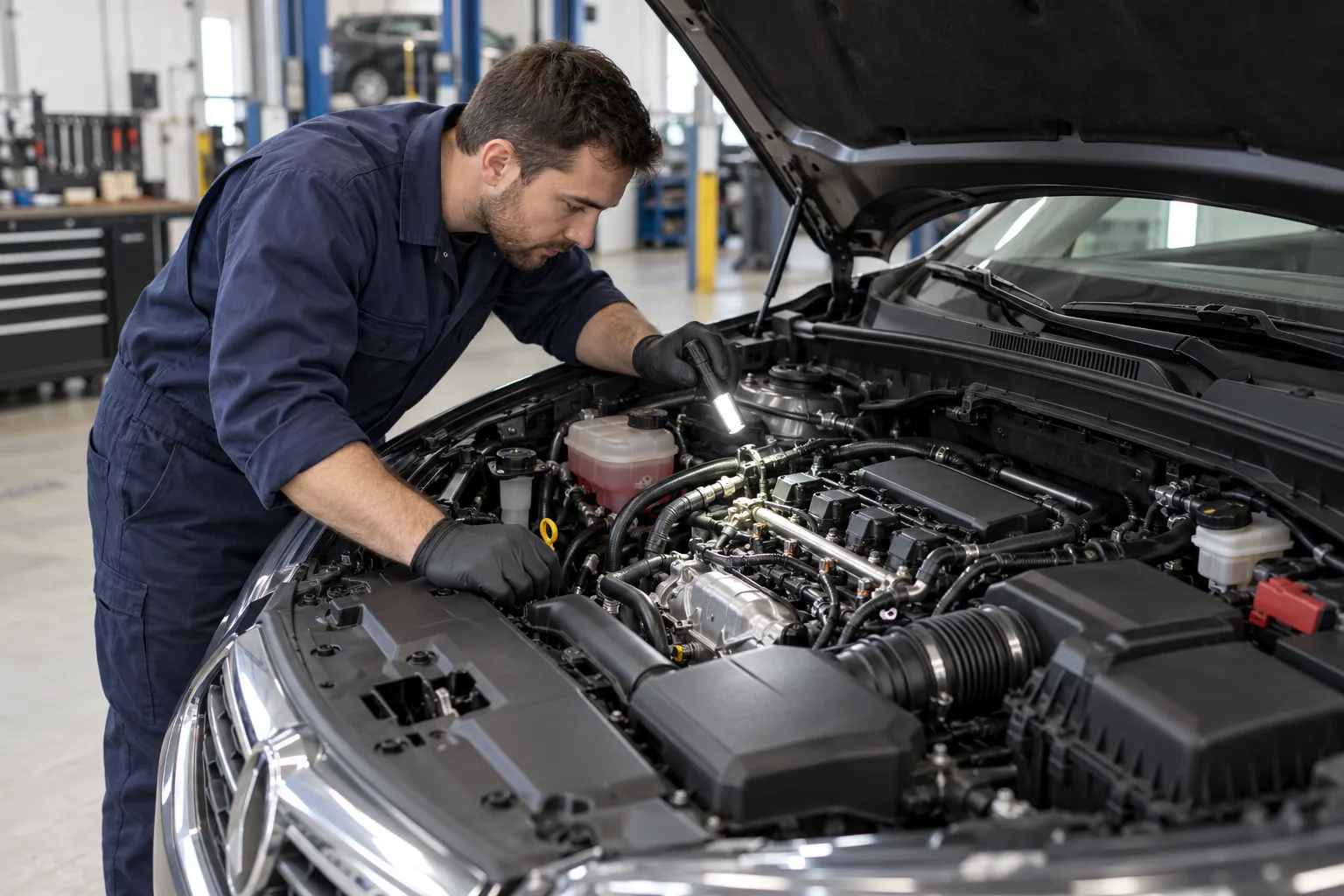
A professional vapour-system leak test is different from testing the fuel-delivery system. Appropriate equipment and the correct vehicle procedure matter. Do not attempt a homemade smoke test or use compressed air to pressurise the tank. Ask what a proposed test checks and how its finding supports the repair.
An intermittent complaint may require a separate testing plan. Record the conditions in which it occurred instead of expecting a quick scan to reproduce it. The workshop should explain any access or testing limitations and obtain approval before extended work.
Diagnosis, transport and repair costs
The cost depends on the confirmed source, access and parts involved. A filler seal, a hose connection and tank removal are different jobs. There is no useful single “gasoline smell repair” price before the cause has been identified.
| Work | Current estimate including 5% VAT | Scope |
|---|---|---|
| Initial fault diagnosis | AED 150–350 | Relevant scan, agreed targeted checks and an explanation of findings |
| Straightforward local recovery in Dubai | AED 120–250 | Standard loading, transport and unloading, subject to location and access |
| Extended tests or repair | Quotation after assessment | Dismantling, specialist tests, parts and repair labour priced separately |
Our diagnostic assessment explains the initial scope and when additional tests need agreement. Recovery distance, difficult access, special equipment, waiting or tolls can change transport charges. Confirm the actual total and the spending limit before work begins.
A repair quotation should name the leak point or failed component, specify the part and explain any access work. Ask what will be checked after repair. A written finding is more useful than replacing several possible causes together without a reason for each.
After repair and during normal maintenance
The workshop should recheck the repaired area using the appropriate procedure and explain whether contaminated surfaces also need cleaning. An odour remaining after a spill requires attention, but it should not be used as the only measure of whether a leak has been fixed.
Keep the invoice and test findings. If the smell returns, describe when and where it happens and stop using the car if a leak is suspected again. A previous repair or a cleared warning does not make a new fuel smell safe to ignore.
For prevention, follow the refuelling instructions, report damaged filler parts and raise new odours promptly. Fuel hoses, seals and emissions equipment should be assessed according to the vehicle’s requirements and condition. Routine replacement of the charcoal canister or ECU is not a general maintenance rule.
Frequently asked questions
Can I drive with a gasoline smell inside the car?
Do not drive or restart a vehicle with a suspected fuel leak. Stop safely, switch off and arrange assistance. Smell alone cannot establish that the cause is only a harmless spill or a filler cap.
Why does the smell appear after filling up?
Possible sources include a spill, filler sealing or vapour-handling equipment. Persistent cabin odour or visible leakage needs assessment. Do not use a fixed waiting time or a lower tank level as proof that the problem is resolved.
Can there be a fuel leak without a warning light?
Yes. Warning lights do not detect every physical fuel leak. A normal-running engine and a clean scan do not cancel a persistent petrol-smell complaint.
Will changing the cabin filter stop petrol fumes?
A cabin filter does not repair a fuel leak or vapour-system fault. First investigate the source. Fragrance and ventilation settings should not be used to conceal the complaint.
Does an EVAP code mean the charcoal canister needs replacement?
No. The code is a starting point for testing. The hose, seal, valve or other relevant component needs assessment before a replacement is selected.
Is a gasoline smell normal in a new car?
Do not dismiss a raw petrol smell as a normal new-car interior odour. Report it to the dealer or an appropriate workshop and follow suspected-leak precautions if it persists or is strong.
Discuss the fuel-smell inspection
Once the vehicle is in a safe place, send your make, model, year and when the smell appeared. Our Al Quoz team can discuss transport and the appropriate inspection. For fire or immediate danger, contact emergency services first.