If your car shuts off after starting, first establish whether only the engine has stopped or the whole vehicle has switched off. A hybrid engine stopping, an automatic stop-start event or a remote-start timer can be normal. An unexpected stall, a dashboard that resets or a vehicle that loses its drive-ready state needs a different investigation.
The important clues are the starting method, the exact dashboard message and what happens immediately before the shutdown. This guide helps you separate normal operating features from a fault and decide what to record before arranging help. It cannot confirm that a car is safe to drive from a symptom alone.
Make the situation safe first
Do not keep restarting a car that stalls unexpectedly. Stop further attempts if you smell fuel, see a leak or smoke, hear severe knocking or suspect that the wrong fuel has been added. Keep away from ignition sources and arrange assistance.
If the car shuts off while moving, concentrate on steering and bringing it to a safe stop. Braking or steering assistance may be reduced, so more effort can be required. Do not deliberately turn off the ignition or select Park or Reverse while the vehicle is moving. Use hazard lights when safe and follow the emergency instructions for your model.
Once stationary, secure the vehicle using its normal parking procedure. Do not run it in an enclosed garage to investigate the problem. A successful restart does not establish that an intermittent stall has been repaired. If the behaviour is unexplained or repeats, keep the car parked and discuss recovery rather than testing it in traffic.
Identify what actually switches off
“The car turns off” can describe several different events. Look at the instruments from the driver’s seat while the vehicle is safely stationary. Engine noise, a zero reading on the rev counter and a working radio do not, individually, tell you whether a hybrid is ready to move or a conventional engine has stalled.
| What you notice | What it could mean | What to check next |
|---|---|---|
| The hybrid engine becomes silent but the normal ready indication remains | The vehicle may still be operating normally | Read the hybrid operating section and check for fault messages |
| The engine stops at a standstill with the stop-start indication showing | A commanded automatic stop may have occurred | Compare the restart behaviour with the handbook |
| It stops after a remote start or during the transition to driving | A timed run or a model-specific handover condition may be involved | Check the remote-start instructions and starting method |
| A shutdown countdown appears after extended idling | An automatic shutdown feature may be active | Read the exact message and model instructions |
| The engine cuts out unexpectedly, runs roughly or will not restart normally | A starting or running fault needs investigation | Record timing, warnings and recent changes |
| The dashboard blacks out, reboots or loses its settings | The complaint includes electrical power loss | Report the reset as well as the engine stopping |
These patterns help describe the complaint. They do not prove a failed component or confirm normal operation. A feature that normally stops an engine can also develop a fault. Missing ready indications, warning messages or failure to restart as the handbook describes should not be dismissed simply because the car has that feature.
When a hybrid engine stopping is normal
A hybrid has a combustion engine and an electric drive system. Depending on its design and operating conditions, the engine can run and then stop while the vehicle remains switched on. The start button may activate the drive system without producing continuous engine noise.
Use your model’s ready indication and instructions rather than listening for the engine. Honda’s e:HEV overview explains how its electric motor and petrol engine share propulsion. That example does not establish how every hybrid sold in the UAE should behave.
A quiet engine alone is therefore different from a vehicle that unexpectedly exits its ready state. Report a hybrid-system warning, a missing ready indication or a shutdown that prevents normal operation. Do not test the distinction by accelerating or selecting a drive position in a confined space.
When parking or leaving the vehicle, use the complete shutdown procedure in the handbook. Silence does not mean the vehicle is switched off. Do not work in the engine bay while a hybrid remains ready, and leave high-voltage cables and components to appropriately trained personnel.
How automatic stop-start differs from a stall
Automatic stop-start can switch the engine off when the vehicle is stationary and restart it when the required conditions are met. The stop indication, gear position and restart trigger depend on the model and transmission. Read those instructions before treating a quiet engine at a junction as a breakdown.
The system may also keep the engine running when battery condition, cabin cooling demand or other operating conditions require it. Ford lists temperature, battery charge and climate-control requirements among its stop-start operating limitations. In Dubai, note whether the air conditioning was working hard, but do not assume that the weather explains an unexpected stall.
The distinction is whether the car performs its commanded stop and restart normally. Rough running before it stops, a fault message or failure to restart as instructed needs assessment. Disabling stop-start does not prove that an unrelated engine or electrical fault has been fixed.
If the symptom began after battery work, tell the workshop which battery was fitted and whether any model-required setup was completed. Battery specification and registration requirements vary. Do not replace a battery solely because automatic stop-start is unavailable.
Check remote-start timing and the driving handover
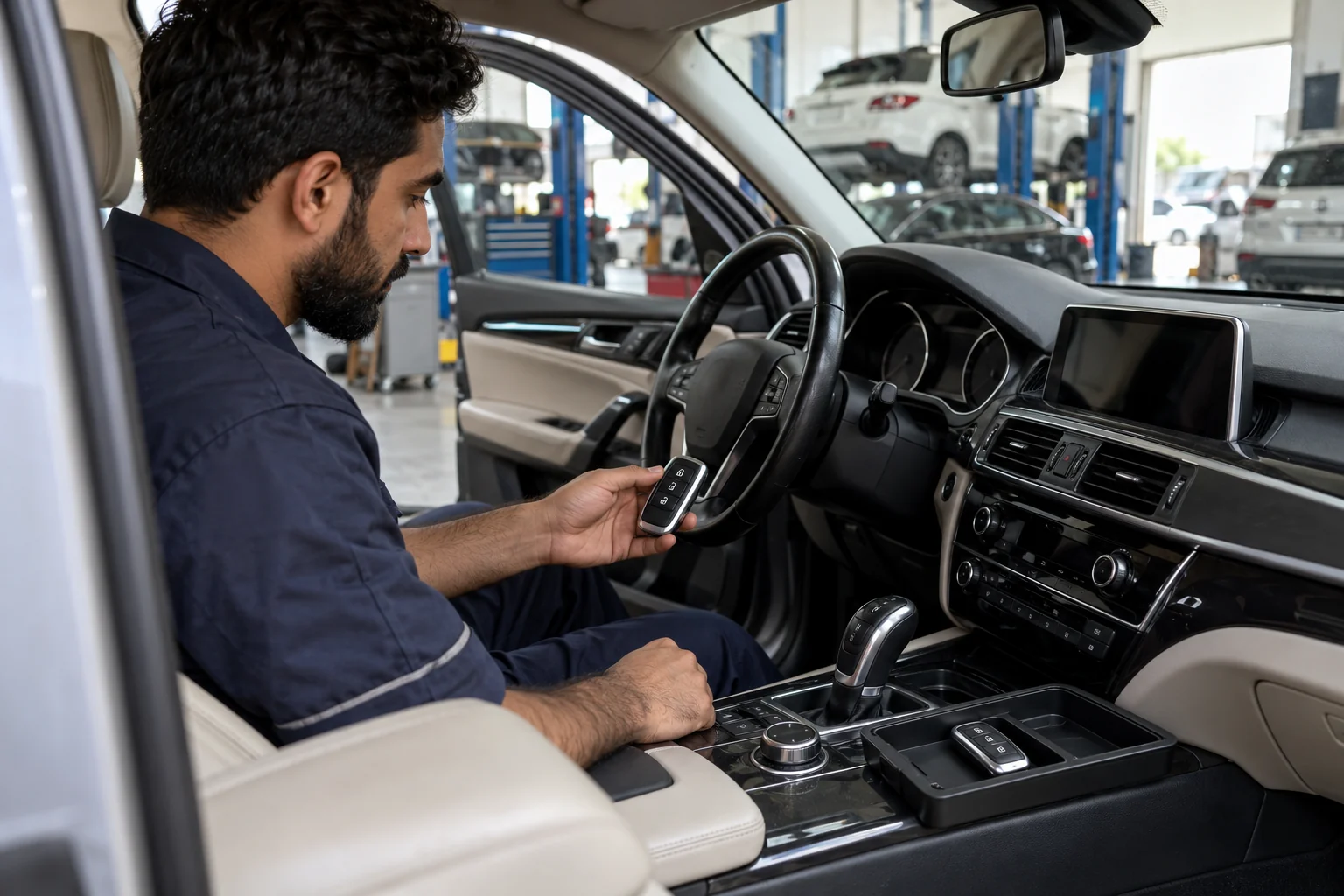
Starting through a phone app or remote key is a different operating mode from starting in the driver’s seat. Some systems run for a limited period and require a particular sequence before driving. First say whether the shutdown happens during the timed run, when you enter the car or when you begin the driving handover.
For example, Ford’s remote-start instructions describe selectable run times and a key-dependent handover procedure for the vehicles covered by that manual. The rules are an example, not a universal procedure for another manufacturer, model year or regional specification.
Check your own handbook and app instructions. Do not assume that a remotely started car is ready to drive merely because the engine is running. If normal starting works but remote starting consistently fails, record that difference before anyone begins replacing engine parts.
For a separately installed remote-start system, provide its make and installer details as well as the vehicle information. Its configuration needs to be considered alongside the car’s own security system. Do not bypass a bonnet switch, immobiliser or other safety input to keep it running. Avoid remote starting in enclosed or poorly ventilated spaces.
Read any automatic shutdown message
A stop after extended stationary idling is a different complaint from a stall within moments of starting. Some vehicles include an automatic shutdown function, and their displays may show a countdown before switching off. Photograph or write down that message if it is safe to do so.
The Ford hybrid manual’s automatic shutdown section describes a countdown and a subsequent shutdown notification. Check whether your own vehicle has an equivalent feature. Do not apply that manual’s timing to an unrelated car or override a shutdown feature to leave a vehicle running unattended.
If there is no matching handbook explanation, or the car switches off much sooner than the documented feature allows, report the actual sequence. “It stopped after idling” is useful, but the displayed reason and whether the ignition also switched off make the description much more precise.
When the shutdown looks like a fault
The engine stops but the dashboard stays on
A working dashboard does not prove that the engine’s control system still has the supply or signals it needs. Note whether the engine stops cleanly or shakes and loses speed first. Also distinguish warnings that appeared while it was running from lamps that became visible only after it stopped.
Possible investigation areas include fuel delivery, intake and idle control, engine-position signals, electrical supply and start authorisation. These are testing directions, not a shopping list. Petrol and diesel engines have different combustion systems, and vehicles do not all use the same idle-control hardware.
For the detailed checks behind an unexpected start-and-stall event, see our guide to why a car starts then dies. It covers the fault systems in more depth. Avoid holding the accelerator down to keep an unexplained stall from happening, or disconnecting sensors as a roadside diagnosis.
The dashboard or other electrical systems reset
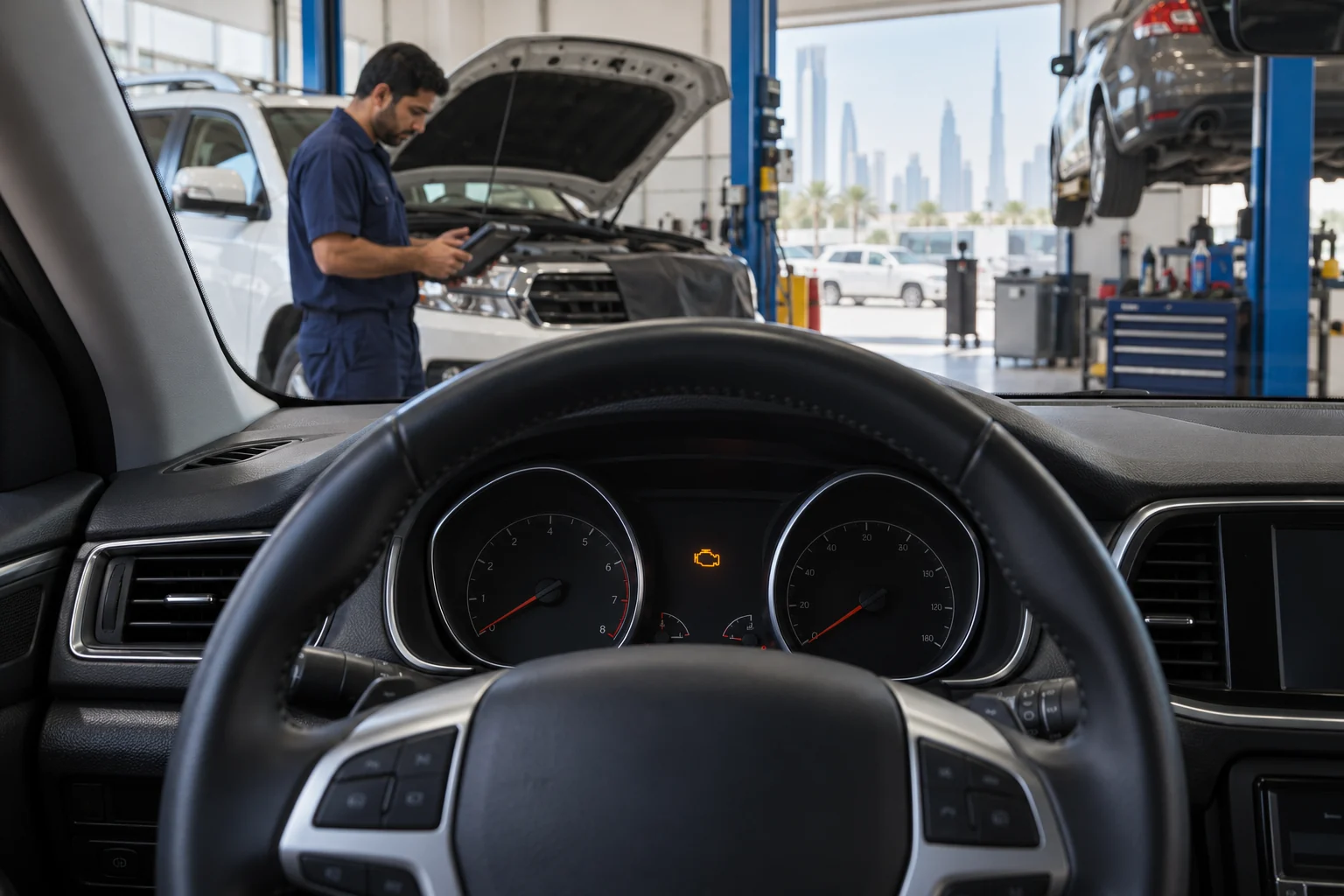
If the instruments go dark or reboot at the same time, describe that explicitly. The workshop needs to investigate power supply and connections as well as the engine complaint. Report whether lighting, the central display or saved settings also changed, rather than using “battery problem” as the diagnosis.
A battery test is one part of that assessment. Supply checks, grounds, wiring and the appropriate charging-system checks may also be needed. Hybrid and conventional charging arrangements differ, so a generic alternator assumption is unsuitable for every vehicle.
Do not disconnect a battery to test whether the car continues running. Do not accept a jump-start or a cleared warning as proof that the underlying shutdown has been resolved. Ask what the test showed and which additional checks support any proposed replacement.
Record the details that help an inspection
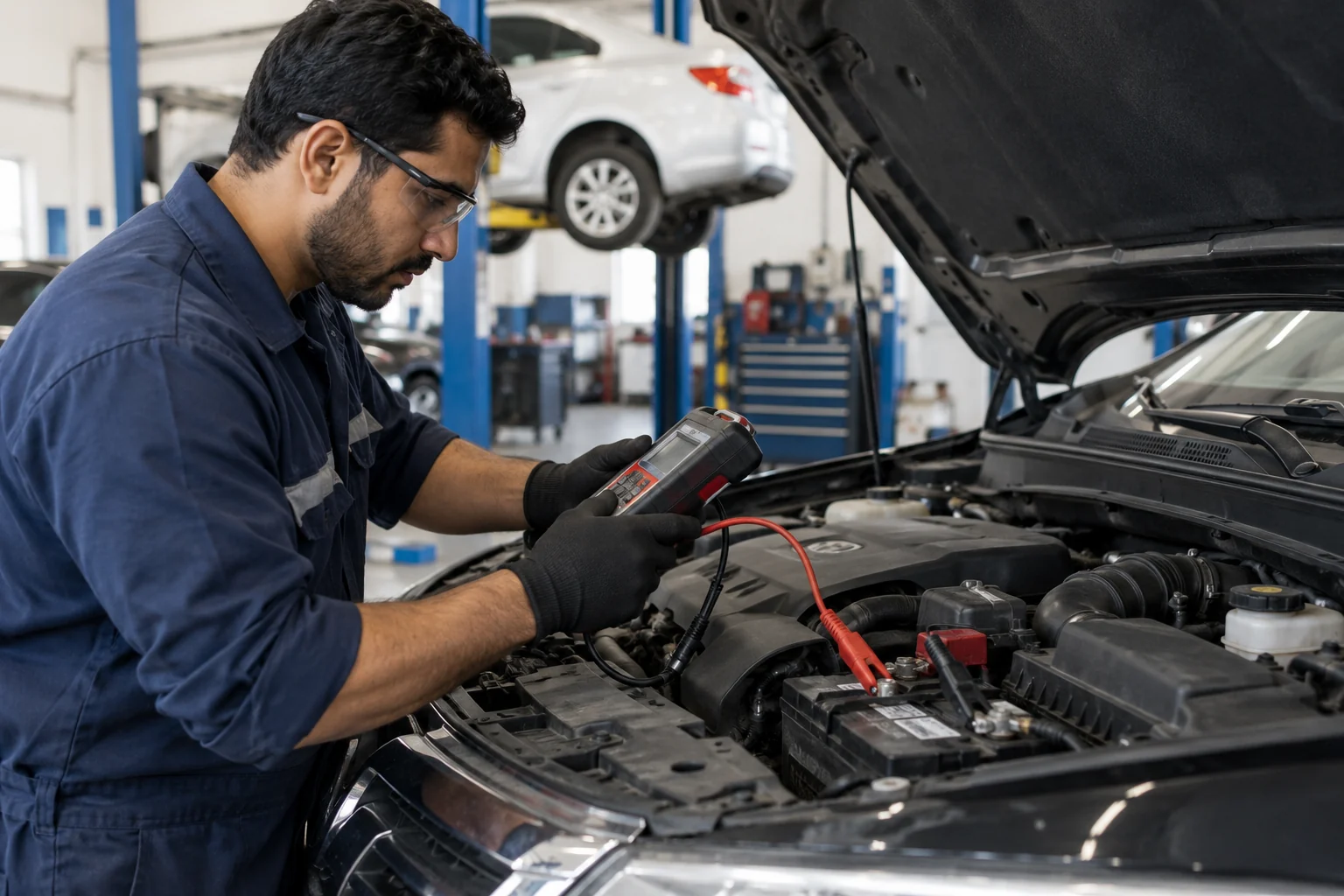
You do not need to reproduce the problem repeatedly to provide a useful description. Start with what you have already observed. A short written sequence is often more useful than a video that shows only the car after it has stopped.
- Give the make, model, year, engine or hybrid type and whether the vehicle is a GCC specification or an import.
- Say whether you used the normal key, start button, factory app or a separately installed remote-start system.
- Estimate how long it ran and say whether it was a first start, a warm restart or an extended idle.
- Copy the exact message and state whether the dashboard stayed on, reset or lost its ready indication.
- Describe rough running, shaking or an abrupt cut, without guessing which component failed.
- Mention recent refuelling, battery replacement, servicing, key work or accessory installation.
If you already have a safe photograph of the display, preserve it. Do not film while driving or keep starting the car solely to capture a better clip. Keep both the original observations and any later changes, such as a car that now cranks but no longer fires.
Agree on diagnosis before approving parts
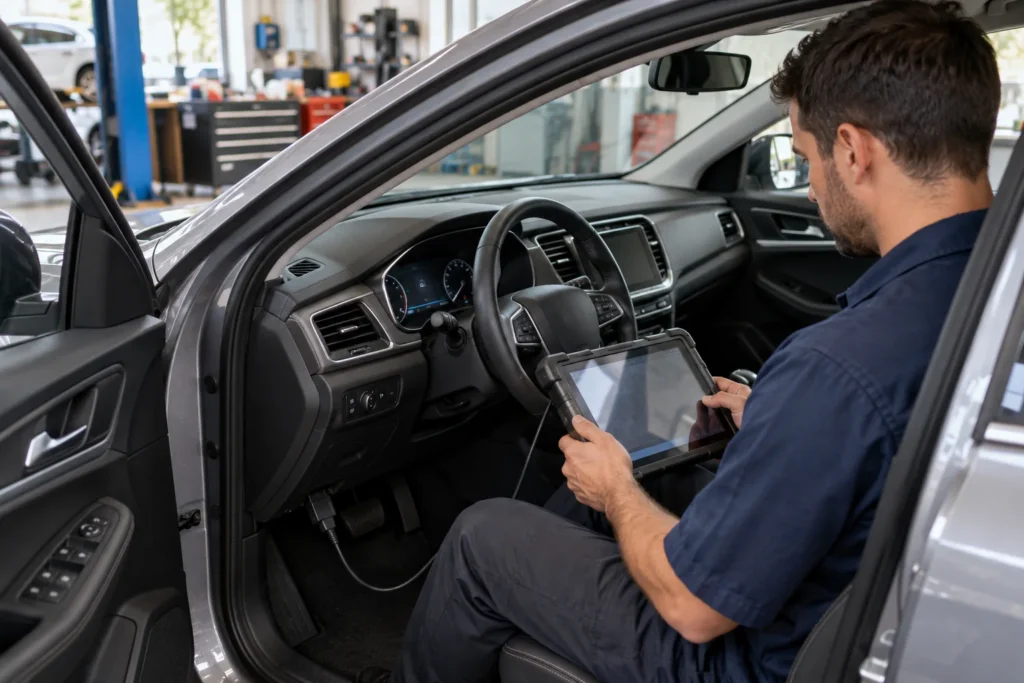
A useful inspection begins with confirming the starting mode and the owner’s description. The technician can compare any normal shutdown feature with the vehicle’s specification, then examine recorded faults and relevant live data. An intermittent fault may require more than a short scan or one warm restart.
Ask which modules were checked and how the findings relate to the actual event. A fault code identifies a condition or circuit that needs interpretation. It is not, by itself, proof that the named sensor or control unit requires replacement. Equally, no stored code does not rule out a power interruption or another intermittent problem.
Our computer diagnostic inspection page explains the service route. When arranging an assessment, describe whether the car can remain running and whether recovery is needed. Keep the diagnostic scope separate from approval for repairs.
What the written quote should clarify
There is no reliable fixed repair price for a symptom that could be a normal feature, an installation issue or a vehicle fault. Ask for the diagnostic charge and authorised investigation limit first. If further testing is needed, agree on its scope before it proceeds.
A repair estimate should identify the confirmed finding, parts and labour, any coding or adaptation, and whether VAT is included. Clarify whether diagnostic charges are separate or credited against an approved repair. Ask what remains uncertain before authorising expensive parts, especially a control unit.
What to check before collection
Ask whether the original conditions were reproduced, such as a first start after standing or the remote-start handover. A warm engine restarting successfully does not demonstrate that a cold-start complaint has disappeared. If the fault could not be reproduced, request a record of the checks completed and the next step if it returns.
After an identified repair, verification should address the reported shutdown and any related warnings. Continue the manufacturer’s service schedule rather than replacing pumps, sensors or control units routinely to prevent an unspecified stall.
Questions about a car shutting off after starting
Can a hybrid engine stop even though the car is still on?
Yes. Engine silence can be part of normal hybrid operation while the vehicle remains ready. Check your model’s ready indication and handbook. A warning, missing ready indication or inability to operate normally needs a separate assessment.
Why does the car stop after I start it with the remote?
A timed run or a model-specific handover condition may explain it. Compare the exact event with your handbook and app instructions. A repeated failure outside those rules needs investigation, including any separately installed remote-start system.
Does turning off stop-start solve an unexpected stall?
It does not establish that a fault has been repaired. Normal automatic stops and unexpected stalls are different events. Report rough running, warning messages or failure to restart as instructed even if disabling the feature changes the symptom.
Can the engine stall while the radio and dashboard still work?
Yes. Accessories remaining on do not prove that the engine has the supply, authorisation or operating signals it needs. Record what stayed on and when warning lamps appeared so the inspection can address the actual sequence.
Does a key-not-detected message prove the key caused the shutdown?
No. Key detection and running behaviour vary by model. Some vehicles can remain running after the key is no longer detected. Preserve the message and describe the starting method. Follow the model’s backup-start instructions rather than bypassing its security system.
Should I drive if it restarts successfully?
A successful restart alone does not explain an unexpected shutdown. If the event repeats, there are warnings or the cause remains unclear, keep the vehicle parked and discuss inspection or recovery. A recognised normal feature still needs to behave as the handbook describes.
Explain the shutdown before arranging an inspection
Share your car’s model, starting method and exact dashboard message. Tell us whether it stays running and whether recovery may be needed, so the assessment can begin with the right information.