An electric car can suit UAE driving well when you have dependable charging access, enough range for your usual journeys and support for the exact vehicle you buy. Compare the Tesla Model 3 for a sedan, the Model Y or BYD SEALION 7 for a family crossover, the MG4 for a hatchback and the BYD SEAL or Polestar range for further sedan and SUV choices. Start with your parking and charging routine before choosing the badge.
There is no single best EV for every driver. Someone who can charge overnight at home faces a different decision from someone who must make a separate trip to a public charger. The useful comparison includes purchase price, time spent charging, passenger space, insurance, warranty and the condition of a used car.
Decide whether an EV fits your routine
This guide focuses on battery-electric vehicles, or BEVs. They use a traction battery and electric motor without a petrol or diesel engine. They have no exhaust emissions while driving, although vehicle production, electricity generation and other sources such as tyre wear still have environmental effects.
| Powertrain | How it gets energy | Main buying question |
|---|---|---|
| Battery-electric car | Plug-in charging, with some energy recovered during braking | Can you charge reliably and cover your routes with a reserve? |
| Plug-in hybrid | A rechargeable battery plus petrol or diesel, depending on the vehicle | Will you charge regularly and maintain both power systems? |
| Full hybrid | Fuel, with the engine and regenerative braking supporting its smaller battery | Would driving without external charging suit your routine better? |
If dependable charging is difficult, compare an EV with the hybrid cars available in the UAE before committing. A plug-in hybrid advertised with a long combined range is not offering that entire distance on electricity alone.
Write down your normal daily distance, the longest regular round trip and where the car stays overnight. Include occasional detours and the days you cannot use your preferred charger. That gives you a useful requirement to test against the actual vehicle.
Compare electric cars around your everyday needs
The following models appear in current UAE manufacturer or distributor channels checked on 6 October 2026. They are a practical shortlist, not a reliability ranking. Confirm the offered grade, build year, delivery date and equipment before comparing quotations.
| Electric car | Why include it | What to check in person |
|---|---|---|
| Tesla Model 3 | A sedan to compare for commuting and longer journeys | Rear access, seating comfort, screen controls and the chosen version’s range |
| Tesla Model Y | A crossover to compare for family use | Exact seating layout, luggage fit, parking dimensions and delivery timing |
| BYD SEAL | An alternative electric sedan | Grade-specific battery and equipment, local warranty and cabin access |
| BYD SEALION 7 | A family crossover alternative | Rear-seat and luggage space, charging specification and installed-charger offer terms |
| MG4 EV | A hatchback to compare with larger sedans and SUVs | Rear-seat fit, boot space and the battery, trim and service support offered |
| Polestar 4 | A further premium crossover choice | Visibility systems, cabin controls, grade, warranty and available stock |
| Polestar 3 | A premium SUV to compare for passenger comfort | Wheel and equipment choices, ride comfort, charging support and complete quotation |
Compare current prices without mixing different offers
Use a purchase price rather than a monthly payment after an assumed deposit or fuel saving. These advertised examples were checked on the official UAE channels on 6 October 2026. They can change and do not establish the final on-road total.
| Vehicle example | Advertised amount in AED | Scope and VAT treatment |
|---|---|---|
| Tesla Model 3 Rear-Wheel Drive | 148,670 purchase price | Observed white paint, 18-inch wheels and black interior configuration. Confirm VAT and final order charges. |
| Tesla Model Y Premium Rear-Wheel Drive | 178,670 purchase price | Observed white paint, 19-inch wheels and five-seat black interior configuration. Confirm VAT and final order charges. |
| Polestar 4 | From 169,900 | Official advertised starting offer. Confirm grade, available stock, VAT and on-road inclusions. |
| Polestar 3 | From 199,900 | Official advertised starting offer. Confirm grade, available stock, VAT and on-road inclusions. |
Ask BYD and MG for a current written UAE cash quotation for the exact model and grade. Avoid carrying an old ATTO 3, overseas MG4 or previous-generation price into a different current offer. The Tesla configurations observed also showed delivery estimates in April–May 2027, so confirm timing rather than assuming a listed model is immediately available.
For every car, ask whether the quotation includes registration, insurance, a home charger, installation, service packages and any optional software. A complimentary wallbox does not automatically include the electrical work needed at your building.
Confirm charging access before paying a deposit
Visit the chargers you expect to use at the times you normally park there. Check the connector, working status, access hours, payment method and parking restrictions. A charger on a map may be occupied, unavailable or behind controlled access when you arrive.
Check a home installation as a complete job
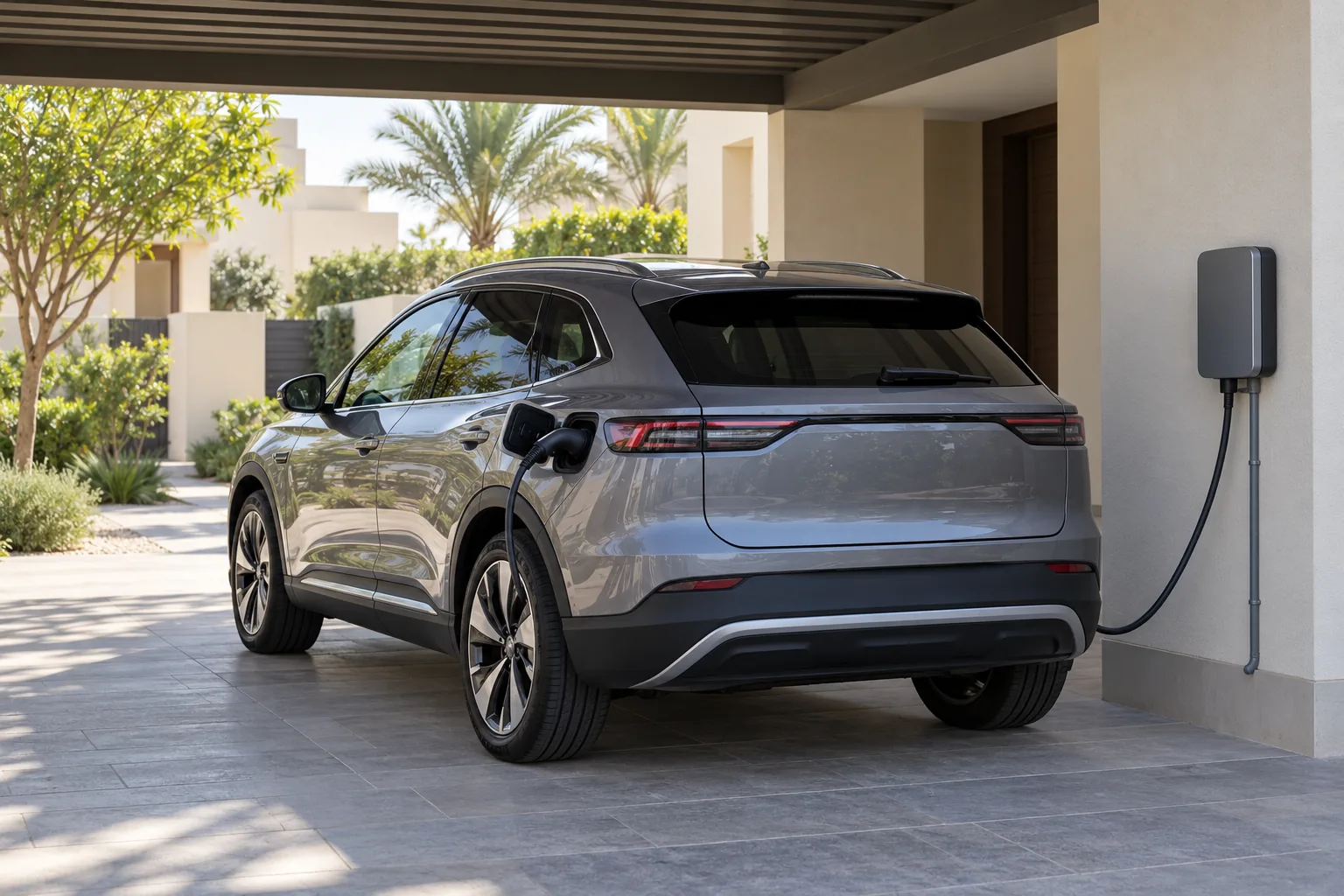
For a villa or assigned apartment space, obtain permission from the owner or building management where required. Have a suitable electrical contractor assess supply capacity, protective equipment, cable routing, charger location and any load-management needs. Follow the relevant authority’s requirements and the equipment instructions.
The installed quote should identify the charger, circuit work, cable length, protection, mounting, testing and VAT. Ask what happens if the planned route or available supply changes. A higher power rating on the box does not guarantee that your car or property can use it.
Do not rely on an extension lead or an unassessed household outlet as your permanent plan. Portable equipment must be approved for the car and used on a suitable inspected supply, within its instructions. Home charging is an electrical installation decision as well as a vehicle accessory purchase.
Test the public charging routine you will use
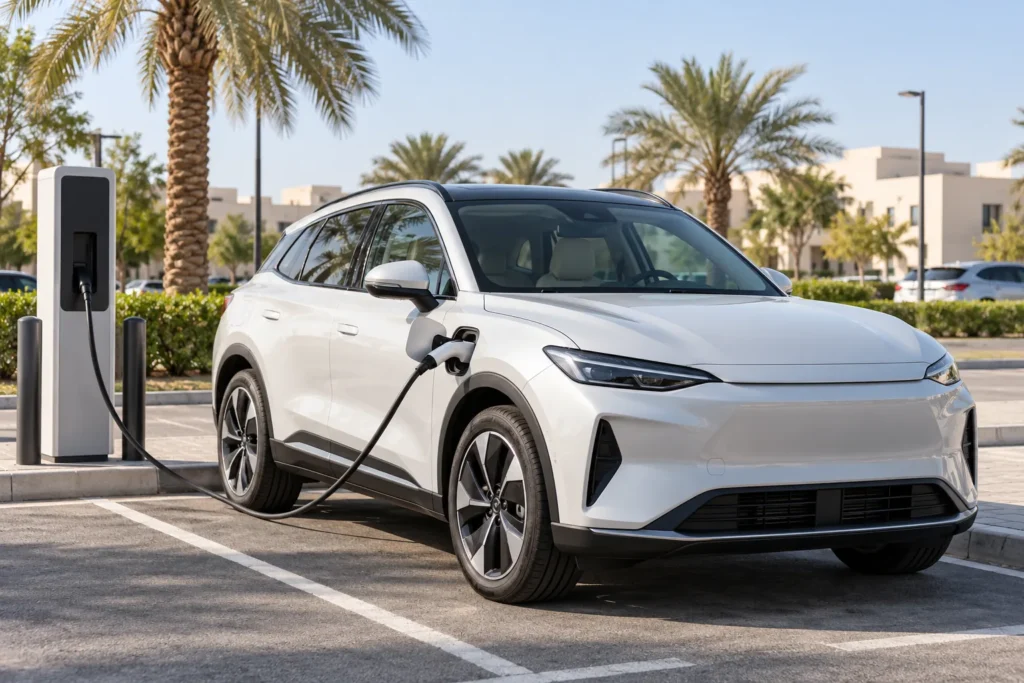
Public-only ownership can work, but compare the time as well as the energy cost. Think about waiting, moving the car when charging finishes and making a separate journey when your usual site is unavailable. Identify a second compatible location rather than depending on one bay.
DEWA provides charger locations and availability through its website and app in Dubai. Other emirates and operators have their own networks and payment arrangements. Check the relevant operator for your routes rather than treating a Dubai account or tariff as a UAE-wide service.
Check connectors and the car’s charging limits
AC charging feeds the car’s onboard charger, which converts electricity for the traction battery. DC fast charging supplies the battery through a different charging path. The car must support the connector, communication and power supplied at that station.
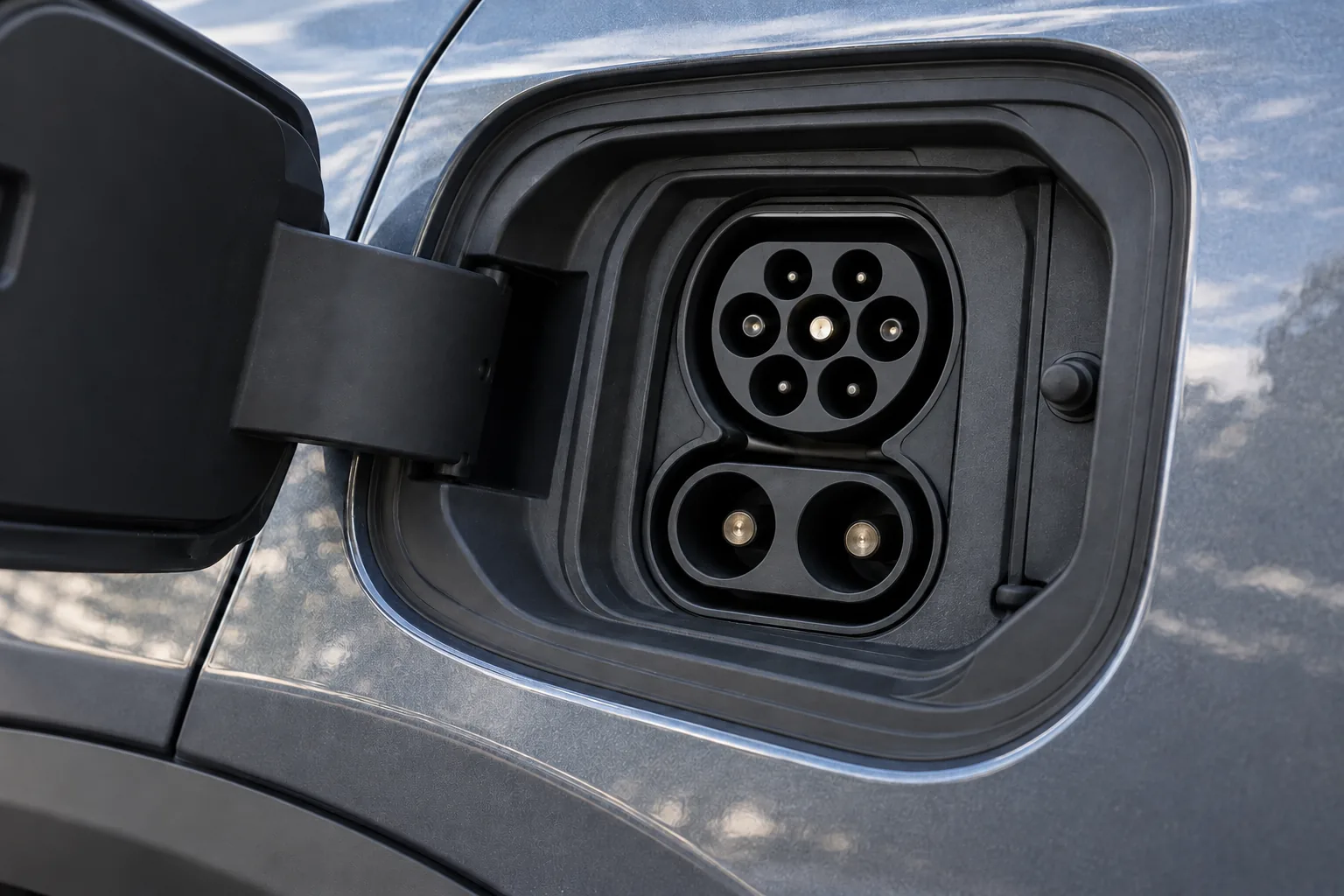
DEWA lists Type 2 AC and CCS/CHAdeMO DC equipment in its network. A locally sold car and an imported car sharing the same model name can have different inlets. Check whether the exact vehicle uses Type 2, CCS Combo 2, GB/T or another arrangement, and identify the compatible stations you will actually use.
A physical adapter is not proof of safe or supported compatibility. Get written confirmation from the vehicle and charging-equipment providers before buying or using one. Authentication, communication, power limits and warranty exclusions can matter as much as the plug shape.
Read the conditions behind a fast-charge claim
Compare the same charging window, such as 10–80%, and the same battery version. Starting charge, battery temperature, the station’s available output and power sharing affect the session. Charging usually slows as the battery fills, so the peak kW figure does not describe the entire stop.
For AC charging, the onboard limit and available electrical supply determine the practical rate. A car limited below the wallbox’s rating will not gain that higher rate merely by connecting to it. Check the vehicle’s single-phase and three-phase requirements with the installer.
Calculate charging costs from billed energy
DEWA’s published service information lists registered-user Green Charger rates of AED 0.70 per kWh for AC and AED 1.20 per kWh for DC, before VAT. Guest packages and other operators need their own checks. The figures below apply 5% VAT and were reviewed on 6 October 2026.
| Charging arrangement | AED per kWh including VAT | 40 kWh example including VAT |
|---|---|---|
| DEWA registered public AC | 0.735 | AED 29.40 |
| DEWA registered public DC | 1.260 | AED 50.40 |
| Home DEWA electricity, marginal slab examples | 0.3045–0.4620 | AED 12.18–18.48 |
The home examples combine the published electricity slab rates of AED 0.23–0.38 per kWh with October 2026’s AED 0.06 fuel surcharge, then VAT. Actual added consumption can cross slabs. These examples exclude charger purchase, installation and fixed bill charges. Use your current bill and DEWA’s electricity tariffs when preparing your own calculation.
A session’s billed energy is not necessarily identical to the battery capacity added, because charging and vehicle systems use energy. Forty kWh is a worked example, not the cost of fully charging every EV. Confirm the session price, parking and any overstay or service fees before starting.
For a monthly comparison, multiply expected billed charging energy by the rates you will use. Then add installation, insurance and other ownership costs. Compare that with the petrol car’s actual consumption and current fuel price without assuming a fixed saving for every driver.
Plan range around your actual UAE journeys
A certified range is a comparison figure, not a promise that the car will travel that far on your route. Keep the measurement cycle beside the number. WLTP, EPA, NEDC and CLTC results should not be mixed into a single ranking as though they use identical tests.
Ask for the exact battery, drive configuration and wheel size. Higher road speed, passengers, luggage, headwinds, elevation and air conditioning affect energy use. A larger certified range can be helpful, but the arrival reserve and available charging stops matter more than the largest number in a brochure.
Check comfort and charging in hot weather
Use a test drive that resembles your normal journey and check cabin cooling after the car has been parked. Follow the manufacturer’s heat and charging instructions. Where supported, cooling the cabin while connected can reduce the battery energy needed at departure.
Battery thermal management may use energy or adjust charging performance. That does not justify a universal summer range-loss percentage, and it does not mean every range change is battery damage. Check the car’s consumption information and warnings rather than diagnosing it from one estimate.
For trips between emirates, plan a compatible stop and an alternative, confirm access and use the car’s route planner where supported. Allow a reserve for detours and unavailable bays. A route you can only finish by using nearly all the displayed charge is a poor everyday plan.
Use the daily charge limit shown for your battery and follow its handbook. There is no single 80% or 100% rule for every chemistry and version. Before long parking periods, check storage instructions and energy-consuming features rather than leaving the car near empty.
Check local support for the exact vehicle
Separate an official UAE supply from a parallel import. An imported vehicle is not automatically unsuitable, but its original market can affect charging hardware, app access, maps, connected services, warranty and the parts or procedures available locally.
- Match the VIN, build year, battery and drive version to the paperwork.
- Ask the relevant local provider to confirm warranty and service eligibility in writing.
- Demonstrate app ownership transfer, account access and features you intend to use.
- Confirm the charging inlet and test compatible AC and DC charging where supported.
- Check recall completion, repair history and registration eligibility for that vehicle.
Do not assume a seller’s description of “GCC spec” settles every point. Equally, a low import price should not be compared with a supported new-car quote without accounting for condition, warranty, equipment and any compatibility work.
Older Leaf, Zoe, Bolt, i3, EQC and other EVs may appear as used vehicles. Identify the particular generation and market rather than treating old specifications as current new-car recommendations. Battery cooling design, connector and parts support need vehicle-specific checks.
Assess a used EV beyond its charge display
State of charge tells you how full the battery is now. State of health concerns its condition or retained capability, measured by a defined method. A dashboard showing 100% charge does not demonstrate that the battery retains its original usable capacity.
Ask what a battery report measures, which tool or vehicle function produced it and under what conditions. A scan and road test can provide useful findings, but neither guarantees the absence of every future fault. Missing data should be recorded as a limitation.

Agree the checks before arranging an inspection
Request records, charging observations, an appropriate diagnostic assessment, a road test and inspection of accessible underbody protection, tyres, suspension, brakes and cooling systems. Check for previous impact, water exposure and repairs. High-voltage work belongs with trained personnel using the required equipment and procedures.
Ask whether both charging paths can be assessed, whether the seller permits the necessary access and what cannot be tested. A successful DC session alone does not prove the onboard AC charger works. A clean regulatory vehicle test is also different from a detailed buyer’s inspection.
Arrange a pre-purchase inspection before paying a non-refundable deposit, with written findings and a clear scope. If the seller refuses reasonable checks, decide whether the remaining uncertainty is acceptable before proceeding.
Read the battery warranty rather than its headline
Compare the time limit, mileage limit, capacity-retention condition, exclusions and local eligibility. The earlier applicable limit usually matters. Warranty cover for a defect is different from a promise that the battery will retain full capacity or never need repair.
For example, Tesla’s current UAE information lists eight-year battery and drive-unit terms with mileage limits that vary by version and a minimum 70% capacity-retention condition. The warranty supplied with the particular vehicle is authoritative. Read the manufacturer’s warranty terms and confirm the remaining cover instead of applying one headline to every EV.
Compare the whole ownership budget before buying
A BEV does not need combustion-engine oil changes, but it still needs maintenance. Tyres, suspension, friction brakes, cabin filtration, air conditioning, low-voltage systems and specified fluids need attention according to the model’s service requirements. Regenerative braking does not remove the need to inspect the conventional brakes.
Get insurance quotations for the actual vehicle before agreeing a purchase. Compare excesses, repair arrangements and the wording relevant to batteries, charging equipment and damage. A lower advertised purchase price can come with different support or repair arrangements.
Build a budget using the cash purchase or total finance cost, charging and installation, insurance, registration, servicing, tyres and a repair allowance appropriate to condition and warranty. Treat a retailer’s free insurance, registration or charging offer as a specific contract benefit, not a permanent government exemption.
Do not assume electric cars always depreciate less or always cost less overall. Compare current used examples, your expected holding period and a cautious resale assumption. The main decision is whether the car remains practical and affordable if charging or repair costs differ from your first estimate.
Complete these checks before ordering your EV
- Choose the body style and exact grade around passengers, luggage and daily routes.
- Confirm your usual charging access and a backup, including home-installation approval if needed.
- Test-drive the car and verify the charging, app and visibility features you will use.
- Obtain the complete written vehicle price, VAT treatment, delivery terms and any offer conditions.
- For a used car, review records, agreed inspection findings and remaining warranty before committing money.
- Confirm insurance, ownership transfer and the applicable handover procedure. Test keys, supplied equipment and account access on collection.
Keep the supporting documents together. A shorter shortlist with clear answers is more useful than choosing from a long table of unrelated battery sizes, old prices and best-case charging times.
Questions about choosing an electric car in the UAE
Which electric car is best for everyday UAE driving?
Compare cars that fit your passengers, routes, budget and charging access. Model 3, Model Y, BYD SEAL and SEALION 7, MG4 and Polestar options provide different body styles and ownership propositions. Test the actual grade rather than relying on a universal brand ranking.
Can I own an EV without a home charger?
Yes, if reliable public or workplace charging fits your routine. Visit the sites, check operating hours and fees, and identify a backup. Include waiting and travel time in your decision rather than considering energy cost alone.
Is public electric-car charging free in Dubai?
Do not assume it is free. DEWA publishes paid rates for registered public AC and DC users, while guest packages and other networks have their own arrangements. Check the operator’s price and any current promotion before starting a session.
Can an imported EV use the same chargers?
That depends on the exact inlet, charging system and supported equipment. Match the vehicle to the stations you will use and obtain written compatibility advice. An adapter that physically fits does not by itself establish safe operation, communication or warranty cover.
Will UAE summer heat make an EV unsuitable?
Assess the particular vehicle, cooling condition and journey. Heat, cabin cooling and road speed can change energy use and charging performance. Follow its handbook and plan a reserve, without treating one generic percentage as every car’s summer range loss.
Should I charge every electric car to 80%?
No single limit applies to every battery and version. Use the recommendation in the car or handbook for daily use, trips and storage. A rule intended for one battery chemistry should not be applied automatically to another.
Does an eight-year battery warranty guarantee full capacity?
No. Read its capacity-retention condition, mileage limit, exclusions and local eligibility. The original vehicle warranty determines what applies, and the remaining time does not by itself prove the battery’s current condition.
What should I check before buying a used EV?
Check identity, history, local support, charging compatibility, app transfer and the remaining warranty. Agree an independent inspection with clearly stated battery, charging and operating checks, and document any limits before paying a deposit.
Discuss an inspection for your shortlisted EV
Share the model, year, original market and seller’s details with our Al Quoz team. We can discuss the proposed pre-purchase checks and confirm the supported scope before you book.