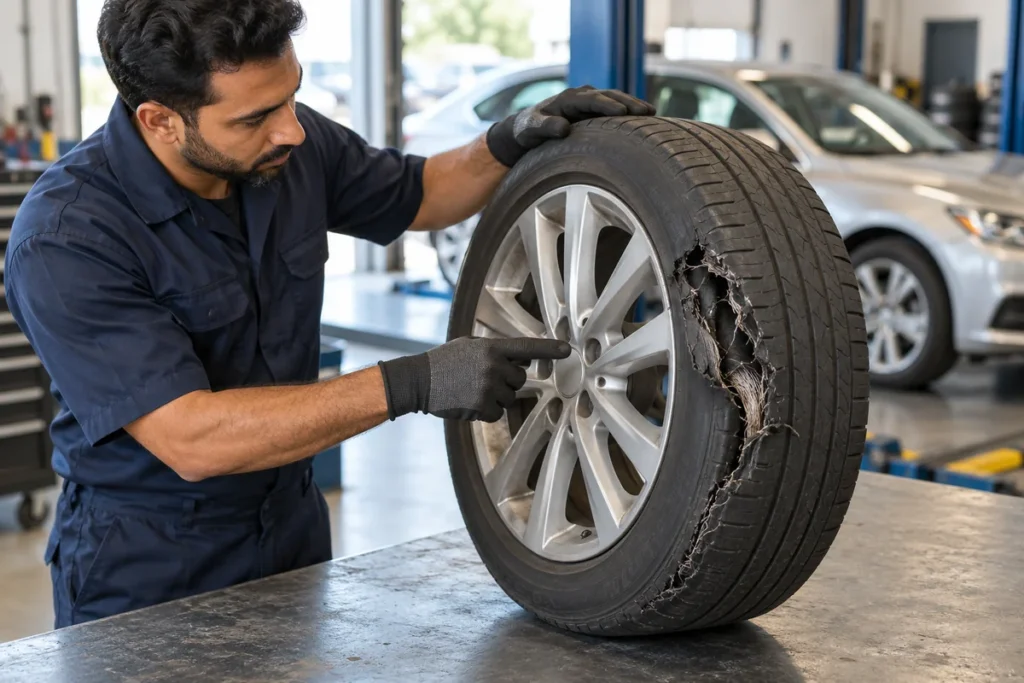
If a tyre blows out while you are driving, hold the steering wheel firmly, avoid abrupt braking or steering, and ease off the accelerator gradually. Once the car has slowed, brake gently and move to a safe stopping place away from moving traffic. A torn sidewall or structurally failed tyre needs replacement. It cannot be made safe by pumping it up or inserting a plug.
Preventing tyre blowouts in Dubai starts with the correct cold inflation pressure, suitable tyres, sensible loading and prompt attention to damage. Heat matters, but a higher pressure reading after driving is not a reason to release air to the cold-pressure figure. The useful questions are whether the tyre is correctly maintained and what to do if its condition changes.
Control the car before choosing where to stop
A bang, sudden vibration or a strong change in handling can indicate rapid pressure loss. Keep your attention on controlling the vehicle rather than identifying which wheel has failed. Avoid a sharp turn toward the shoulder. Hold a steady course, reduce accelerator input gradually and use gentle braking after the vehicle has slowed.
Check surrounding traffic before moving toward a suitable stopping area. Use your hazard lights when you can do so safely. The immediate aim is to stop safely, not to reach a preferred garage or finish the journey. After stopping, do not continue on a destroyed conventional tyre.
- Keep clear of live lanes and passing vehicles.
- Do not stand beside the traffic-facing wheel to inspect it.
- Do not cross the road to collect tyre fragments.
- Follow police or road-operator instructions if the car is obstructing traffic.
If the car cannot be moved out of traffic, or there is an immediate danger or a collision, call the police emergency number 999. Describe the road, direction of travel and nearest identifiable junction or landmark. For an ordinary breakdown in a safe location, contact your roadside-assistance provider. Make the call after stopping safely.
Follow the emergency operator’s advice on where to wait. If you can exit safely on the side away from traffic, move to a protected place off the road. Do not stand directly behind or in front of the car, and do not leave children alone in it.
Decide whether roadside wheel changing is safe
Having a spare does not make every stopping place suitable for changing a wheel. A narrow highway shoulder, poor visibility, soft ground or nearby fast traffic can make the job unsafe. Arrange assistance when you cannot work well away from traffic on a stable, level surface.
Follow the vehicle handbook for its parking, jacking and wheel-changing procedure. The correct jacking points, equipment and wheel-fastener requirements matter. Never put any part of your body under a car supported only by its wheel-changing jack. If equipment is missing, damaged or unfamiliar, leave the wheel change to a trained person.
Check the spare’s condition and pressure before relying on it. A temporary spare may have its own speed, distance and position restrictions. Read those limits on the spare and in the handbook, and arrange the proper replacement promptly. A spare is a way to restore limited mobility, not permission to resume normal high-speed driving.
Treat run-flat limits as specific operating conditions
A run-flat tyre may support limited travel after pressure loss, subject to the tyre and vehicle instructions. It is not immune to a blowout or impact damage. Do not assume every run-flat allows the same speed or distance, or that a shredded tyre remains usable.
Check the warning message and handbook. Severe vibration, visible structural damage or unstable handling calls for stopping and assistance. Tell the technician how far and at what speed the tyre was driven after the warning. That history affects the assessment, including whether the manufacturer permits repair.
Understand why pressure loss becomes structural failure
Underinflation allows excessive tyre flexing and heat build-up. An overloaded vehicle adds further stress. A leak that starts with a small tread puncture can therefore become a much larger problem when the tyre continues to be driven with too little air.
Impact damage is another route to failure. A pothole or kerb strike may damage the tyre, wheel or both. Age-related deterioration, existing injuries and unsuitable fitment also need consideration. Replacing a failed tyre without checking the cause may leave a leak or vehicle problem unresolved.
Give the technician the circumstances rather than guessing the cause. Explain whether there was an impact, a pressure warning, repeated inflation, extra cargo or driving after the tyre became flat. The appearance of the final tear alone may not reveal which problem came first.
Act on damage and repeated pressure warnings
Some tyre problems develop gradually, while sudden failure may provide little warning. A visual check is useful, but it cannot rule out internal damage. Look at the tread and accessible sidewalls without crawling under an unsupported vehicle.
| What you notice | Sensible next step |
|---|---|
| Bulge, torn sidewall or exposed cords | Stop using the tyre and arrange replacement or assistance. |
| Repeated loss of pressure | Have the tyre, valve and wheel sealing surfaces checked rather than repeatedly adding air. |
| New vibration or pulling after an impact | Stop safely and arrange inspection. Do not assume balancing is the whole answer. |
| Worn tread, uneven wear or cracking | Have the condition assessed and any underlying wear problem investigated. |
A tyre pressure monitoring system, or TPMS, provides useful warnings, but it does not replace a gauge or physical inspection. A warning can mean the pressure is already significantly low. A tyre can also be damaged without an advance dashboard alert. Follow the handbook’s response to the specific message.
Check cold pressure using the vehicle’s specifications
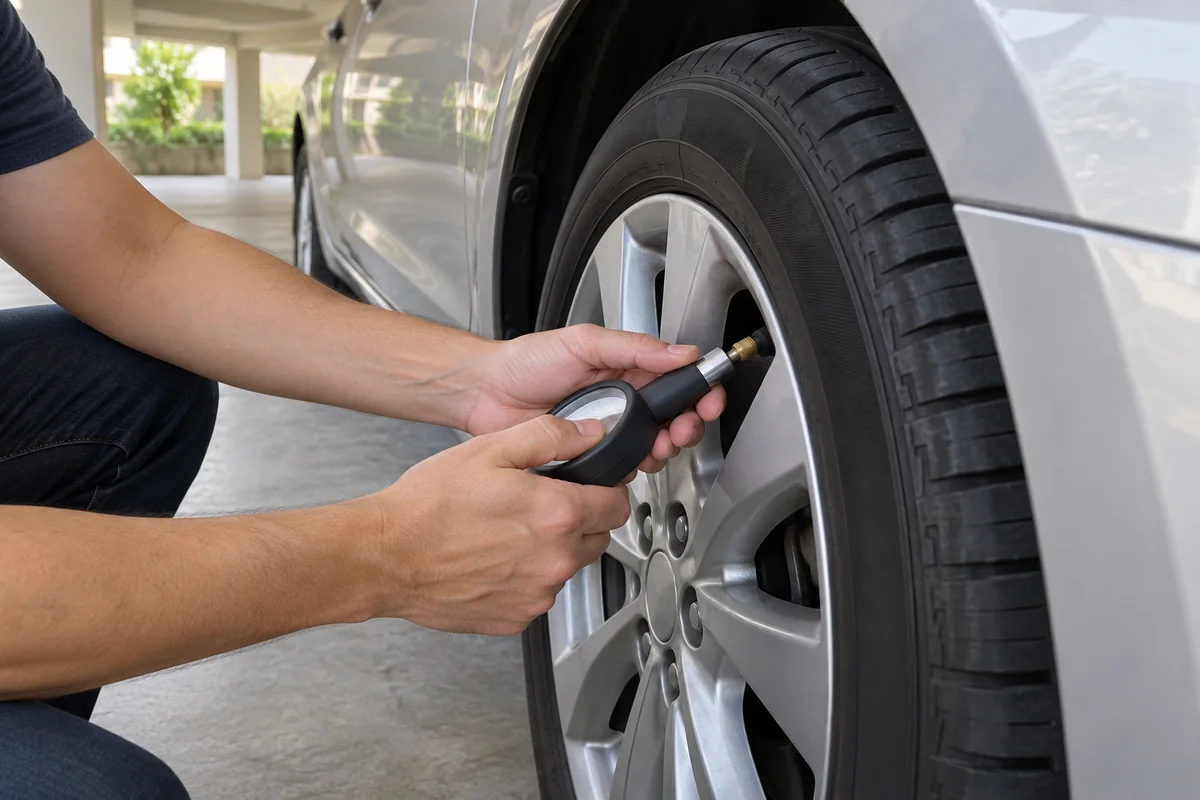
Use the pressure specified on the vehicle’s tyre-information label or in its handbook. The maximum figure moulded on a tyre is not the normal target for that car. Front and rear recommendations may differ, and some vehicles give separate settings for a heavier load.
NHTSA’s tyre maintenance guidance recommends monthly pressure checks when the vehicle has not been driven for at least three hours. Check before long journeys too, including the spare where fitted. Use a reliable gauge and compare each reading with the applicable vehicle specification.
Normal driving warms the tyres and increases pressure. Do not bleed a hot tyre down to the recommended cold figure. Recheck when cold. If a pressure warning appears during a journey, stop safely and assess it rather than dismissing it as a summer effect or adding an arbitrary amount of air.
Air and nitrogen both require pressure checks. Neither fixes a puncture, leaking valve or damaged wheel seal. If a tyre keeps losing pressure, record which tyre is affected and how quickly the loss occurs. That information is more useful than repeatedly changing the inflation gas.
Use tyre age alongside condition and history
The manufacture date is different from the purchase or fitting date. On a tyre carrying a four-digit date code, the first two digits identify the production week and the last two the year. For example, 2424 means the twenty-fourth week of 2024. Ask a tyre professional to identify the marking if it is unclear or on an inaccessible sidewall.
RTA’s published tyre-inspection guidance says a vehicle will not pass with tyres more than five years from manufacture, or with serious wear or cuts. That inspection limit is not a guarantee that a younger tyre is safe. Damage or deterioration can require earlier replacement.
Consider the tyre’s condition, use and manufacturer guidance together. A low-mileage tyre still needs inspection. So does a spare that has spent years in the boot. Do not use visible tread depth alone to decide that an old, cracked or previously damaged tyre can stay in service.
Separate a repairable puncture from blowout damage
A puncture and a blowout are different repair decisions. A small penetration in an otherwise sound tyre may be repairable. A sidewall tear, structural bulge, exposed cords or damage from running flat cannot be resolved by sealing the visible hole.
| Condition | Assessment |
|---|---|
| Small puncture in the permitted tread area | May qualify after the tyre is removed and inspected, subject to the manufacturer’s repair policy. |
| Sidewall or shoulder injury | Outside normal passenger-tyre puncture repair limits. Replacement is required. |
| Torn tyre, bulge or structural damage | Replace rather than attempting a patch, plug or sealant fix. |
| Tyre driven with little or no pressure | Internal inspection is necessary. Damage may make replacement the only safe option. |
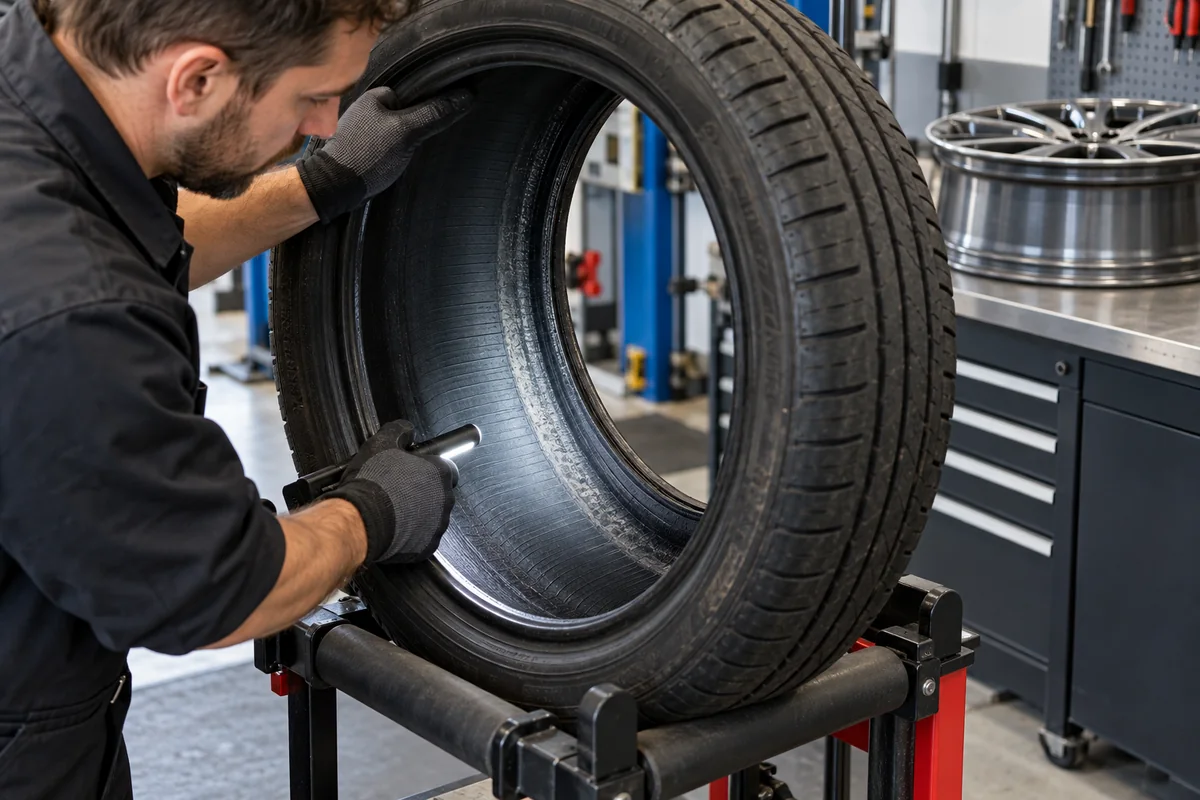
The USTMA puncture repair criteria limit eligible injuries to the tread area and no larger than 6 mm. They require removal from the wheel, internal inspection, a stem filling the injury and a patch sealing the inner liner. A plug alone is not an acceptable permanent repair. Manufacturer restrictions may be narrower.
Do not treat the hole diameter as an approval on its own. Its position, path, previous repairs and the tyre’s overall condition matter. A photograph can help prepare an assessment, but it cannot show all the damage inside. Tell the technician if sealant was used or the tyre was driven flat.
Check the wheel before fitting another tyre
Ask for the wheel to be inspected after an impact or blowout. Relevant checks include the rim, tyre seating surfaces, valve and any fitted TPMS sensor. Explain new noises, steering changes or damage around the wheel arch so nearby components can be assessed where needed.
If the rim was struck, our guide to whether a bent rim can be repaired safely explains why the damage needs assessment before deciding on repair. A new tyre should not be used to conceal an unresolved wheel problem.
Alignment and balancing address different wheel problems
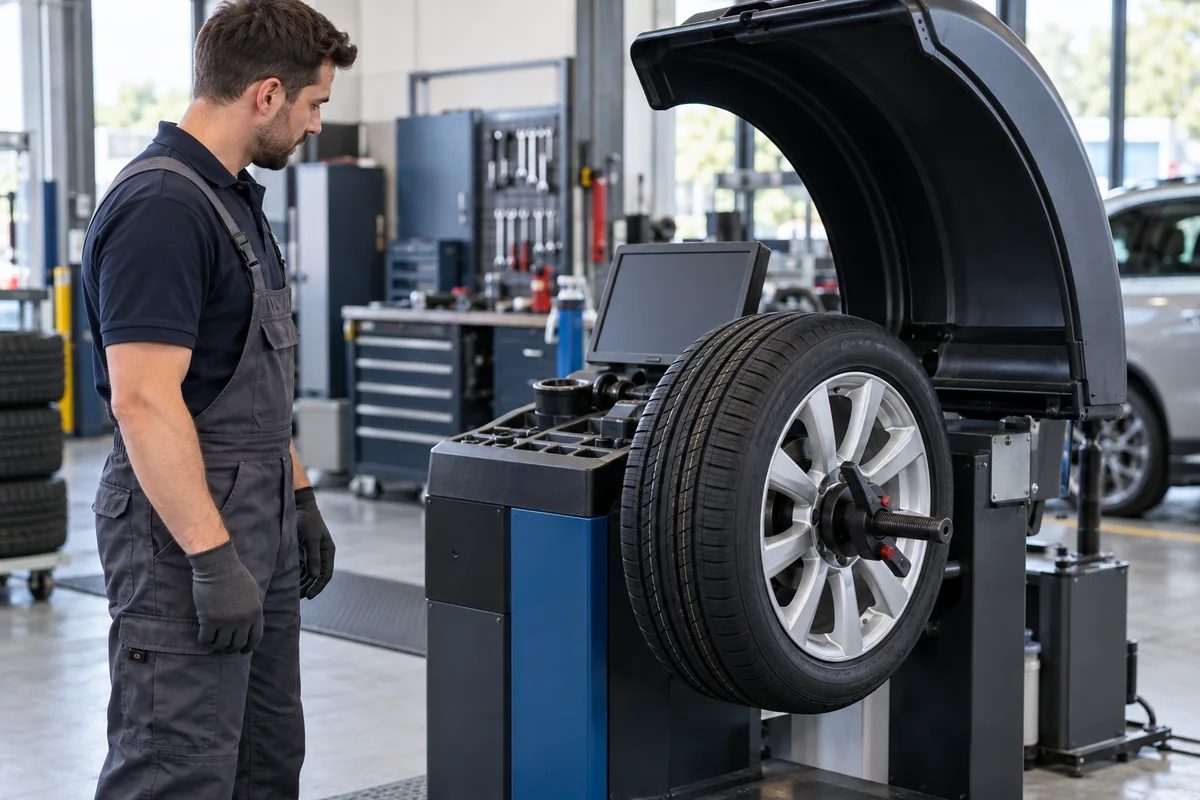
Balancing corrects weight imbalance in the wheel-and-tyre assembly. Alignment concerns wheel angles relative to the vehicle specification. Neither restores a torn tyre. Ask which service is indicated by the findings rather than buying both automatically.
After fitting, the technician should check pressure, seating, balance and wheel fastening as appropriate. A safe verification drive may help assess remaining vibration or pulling. If a symptom persists, have it investigated rather than assuming every post-blowout concern is solved by the replacement.
Match replacement tyres to the vehicle’s requirements
Confirm the full size, load index, speed rating and tyre type required for the vehicle. A tyre that fits the wheel is not necessarily a suitable replacement. Run-flat construction, different front and rear sizes and vehicle-specific fitments require particular attention.
Ask whether replacing one tyre is appropriate given the others’ model, condition and tread depth. Some vehicles, especially particular all-wheel-drive systems, have limits on differences between tyres. Follow the vehicle manufacturer’s requirements rather than a universal rule to replace one, two or all four.
Rotation also depends on the fitment and handbook. Different front and rear sizes or directional tread patterns can restrict the available positions. Do not move tyres around simply to follow a generic kilometre interval. The aim is compatible fitment and appropriate maintenance, not making damaged tyres last longer.
Understand what the fitted replacement price includes
The replacement budget depends on the exact size, tyre model and required specification. The workshop’s current estimates below cover common passenger-car fitments. Large SUV sizes, run-flat versions and specialist tyres need a separate fitted quotation.
| Tyre size or work | Estimated price | Scope |
|---|---|---|
| 195/65 R15 | AED 200–400 per tyre | One new tyre with standard fitting items. |
| 205/55 R16 | AED 210–520 per tyre | One new tyre with standard fitting items. |
| 215/60 R17 | AED 300–720 per tyre | One new tyre with standard fitting items. |
| Eligible tread puncture repair | AED 50–120 per tyre | Internal inspection and a suitable tread repair after assessment. |
These estimates include 5% VAT. The new-tyre figures include fitting, balancing, a standard rubber valve and old-tyre disposal. Alignment, replacement TPMS sensors, special metal valves, recovery and mobile attendance are separate. Balancing should not be added twice to a fitted tyre price.
Request the exact tyre model, availability and complete total before approving work. Ask whether an additional tyre is recommended because of compatibility or condition, and have that reason explained. The puncture estimate does not apply to reconstructing a torn or blown-out tyre.
Prepare the car before your next long trip
Check tyre condition and cold pressures before departure, with time to resolve a problem. Include passengers and luggage when applying the vehicle’s load guidance. A last-minute top-up does not replace investigating a persistent leak.
- Keep the roadside-assistance contact and a working phone available.
- Know whether the vehicle has a spare, a mobility kit or run-flat tyres.
- Check the spare and supplied equipment, or the mobility kit’s expiry and instructions.
- Arrange inspection after an impact, unusual vibration or repeated pressure loss.
A mobility kit is a temporary measure for the damage types described in its instructions. It is not a treatment for a torn sidewall, structural failure or every flat tyre. Good preparation helps you choose assistance promptly when continuing or repairing at the roadside would be unsafe.
Common questions about tyre blowouts and repairs
Can a tyre be repaired after a blowout?
A structurally failed tyre needs replacement. A separate, limited tread puncture may be repairable after removal and inspection, but a torn sidewall or damaged carcass cannot be restored with a plug.
Should I reduce tyre pressure in Dubai summer?
Use the vehicle’s recommended cold pressure. Do not release air from a hot tyre to reach the cold figure. Recheck when cold and follow the handbook’s load settings.
Will TPMS warn me before a tyre blows out?
It can warn about low pressure, but it cannot guarantee an advance warning of every sudden failure. Check pressure with a gauge and take damage or handling changes seriously.
Can I drive to a garage on a flat tyre?
Stop safely after a blowout and arrange a suitable spare or assistance. A run-flat’s limited mobility depends on its instructions and condition. Do not keep driving on a shredded or unstable tyre.
Do I need to replace all four tyres?
That depends on the vehicle’s matching requirements and the remaining tyres’ specification, condition and tread depth. Ask for the reason behind a one-tyre, pair or full-set recommendation.
Does nitrogen prevent tyre blowouts?
No inflation gas guarantees protection from a blowout. Correct pressure, suitable loading and tyre condition still matter. Nitrogen does not remove the need for regular checks or repair a leak.
Need help assessing a damaged tyre safely?
Once you are safely stopped, explore our tyre repair and replacement options and tell the team what happened. Share the size, vehicle details and whether you drove after pressure was lost. Ask about suitable assistance before moving a car that is unsafe to drive.