Bad torque converter symptoms can include a rapid shudder under light acceleration, revs rising without the expected increase in speed, weak pull-away, overheating or stalling as the car slows to a stop. These are clues to investigate, rather than proof that the converter needs replacing. Engine misfire, fluid problems, transmission controls and internal gearbox wear can produce similar complaints.
The most useful detail is when the change happens. A warm-only vibration during steady cruising tells a different story from a thump when selecting Reverse. If the car loses drive, slips severely, stalls repeatedly or displays an overheating or stop warning, stop safely and arrange assistance. Do not keep accelerating to make it move.
Recognise the symptoms before choosing a repair
A torque converter works with the transmission, its fluid and its controls. The same sensation can have more than one cause, and two faults can exist together. Use the pattern below to describe what you notice without committing to a replacement part.
| What you notice | What needs distinguishing |
|---|---|
| Brief rumble-strip vibration on a smooth road | Converter clutch behaviour, fluid condition, engine misfire and driveline vibration |
| Revs rise while acceleration falls behind | Normal ratio changes versus excessive converter slip, internal clutch slip or hydraulic trouble |
| The engine stalls as the car stops | A lock-up clutch that fails to release versus an engine idle, ignition or fuel fault |
| Drive or Reverse takes longer to engage | Fluid level, pressure, controls, clutch engagement and possible converter drain-back |
| Warning, heat or a burning smell | Fluid loss, cooling restrictions, excessive slip and the vehicle’s required response |
| Whine, rattle or grinding | Converter, pump, flexplate, engine accessory and other transmission or driveline sources |
None of these rows is a home diagnosis. If the problem affects several gear changes or includes difficult selection, the broader transmission troubleshooting guide explains the other systems worth checking alongside the converter.
Notice when the shudder starts and stops
Converter clutch shudder can feel like running over closely spaced rumble strips even though the road is smooth. It may appear during light-throttle cruising or gentle acceleration and disappear when the operating conditions change. Some drivers describe a rapid tremble through the seat or floor rather than a single harsh shift.
There is no universal speed at which it must occur. The lock-up strategy depends on the transmission, temperature, selected gear and load. A symptom that happens only after the car warms up still deserves attention, even if the first few minutes of driving feel normal.
Tell the workshop whether the vibration appears during a shift, between shifts or at a steady speed. Also mention whether the engine runs roughly while stationary. A wheel or shaft fault can follow road speed, while an engine problem can change with load, so the surrounding conditions help choose the tests.
Do not try a two-pedal brake-and-throttle experiment on the road to make the clutch release. A technician can compare clutch commands and the vibration under the approved conditions. A change during that test helps locate the concern, but does not automatically decide between fluid, hydraulic control and converter hardware.
Separate slipping and stalling from ordinary operation
Rising revs need the right operating context
A conventional automatic normally allows some difference between engine and transmission input speeds when the converter is transferring power through fluid. A downshift also raises engine revs. Neither event alone establishes a fault.
The concern is a clear change from the car’s usual behaviour, particularly when revs increase but acceleration becomes weak or inconsistent. Note whether this happens during a particular shift or during steady cruising. Persistent slip, loss of movement or violent engagement calls for stopping safely rather than testing with harder acceleration.
Stalling at stops needs engine checks too
If the lock-up clutch remains applied when it should release, it can load the engine as the vehicle slows. That can resemble bringing a manual car to a stop without disengaging its clutch. Engine idle-control, ignition and fuel faults can also cause stalling, so the timing and scan findings matter.
A car that runs roughly in Park or Neutral needs engine investigation as well. Do not repeatedly shift between gears to see whether it stalls again. Report the pattern and let the workshop decide whether a road test is safe.
Noise and heat require a wider inspection
A whine or rattle near the engine-to-gearbox connection does not identify the converter by sound alone. The pump, flexplate and nearby components need consideration. Note whether the noise follows engine speed, changes with gear selection or appears only under load, without crawling beneath a running vehicle.
An overheating message is a reason to follow the vehicle’s instructions promptly. Cooling procedures differ, so there is no blanket instruction to idle every car or immediately switch off every engine. Smoke, a severe leak or loss of reliable drive requires stopping safely and arranging help.
Understand the converter and its lock-up clutch
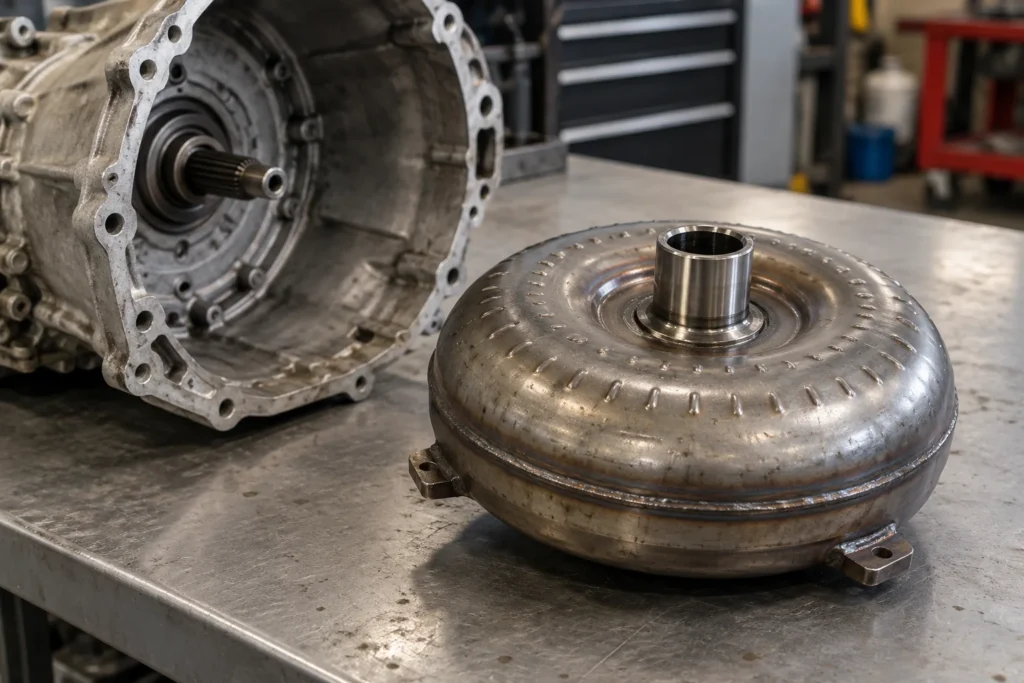
A conventional torque converter sits between the engine and automatic transmission. Its impeller moves fluid, its turbine receives that flow, and a stator redirects the flow to assist torque transfer during pull-away. This fluid coupling allows the engine to keep running while the vehicle is stationary.
The torque converter clutch, often shortened to TCC, provides a mechanical connection that reduces fluid-coupling slip when conditions allow. Modern systems may control that slip progressively. The clutch is therefore not simply a device that switches on once at a fixed motorway speed.
The transmission controller, solenoid and hydraulic passages influence how the clutch applies. A fault in this control path can resemble a worn converter. The solenoid is part of the transmission’s control arrangement and should not be confused with a sensor mounted on every converter.
Confirm that the car actually uses this arrangement. A manual or typical dual-clutch gearbox uses a different clutch system. Some CVTs use a torque converter, while an eCVT label on a hybrid does not establish the same mechanism. The VIN and transmission identification determine which advice and tests apply.
Know what a useful diagnostic assessment includes
An assessment should connect the symptom to evidence. It starts with the vehicle details, service history, recent repairs and the conditions under which the fault occurs. A scanner supports that investigation, but a printed code is not a complete diagnosis.

Preserve fault information before clearing the codes
Ask for the stored fault report and available freeze-frame or event data before a reset. Clearing codes or disconnecting the battery can remove useful information without repairing the cause. A basic engine-code reader may not provide the transmission data needed for the complaint.
P0741 generally concerns torque converter clutch performance or a stuck-off condition. Its meaning must be checked against the fitted vehicle’s service information. Electrical, hydraulic and mechanical findings determine the next action, rather than the code name alone.
A fault can also exist without a converter-specific code. Manufacturer diagnostics sometimes investigate jolting or poor acceleration through operating data even when no relevant code is stored. Equally, a code that returns after clearing deserves investigation rather than repeated resets.
Compare clutch commands with the actual behaviour
Where supported, a technician can examine engine and transmission input speeds, calculated TCC slip, clutch command, selected gear, temperature and engine misfire information. The readings need to be captured when the complaint happens and interpreted using that transmission’s specifications.
Do not judge every gearbox against a universal zero-slip target. Some designs deliberately permit controlled slip. A safe road test may show whether the vibration follows the clutch’s operation or continues when the engine or driveline is the more likely source. Further electrical or hydraulic tests follow those findings.
Use pressure and mechanical tests when justified
Low line pressure concerns the transmission’s hydraulic system, not proof that the converter creates all the pressure for gear engagement. A pump, valve, leak or other internal fault can require investigation. Pressure testing needs the specified procedure and suitable workshop equipment.
Do not perform an improvised stall-speed test by holding the brakes and accelerating hard. It creates heat and load, and its suitability and limits depend on the vehicle. Transmission removal or internal inspection should follow a reasoned diagnosis, with the scope and charge agreed beforehand.
Interpret fluid findings alongside the other evidence
Fluid condition matters, but colour alone does not name the failed component. A burnt smell, unusual contamination or debris can support further checks. The amount and type of residue must be considered alongside the symptoms and the transmission’s condition.
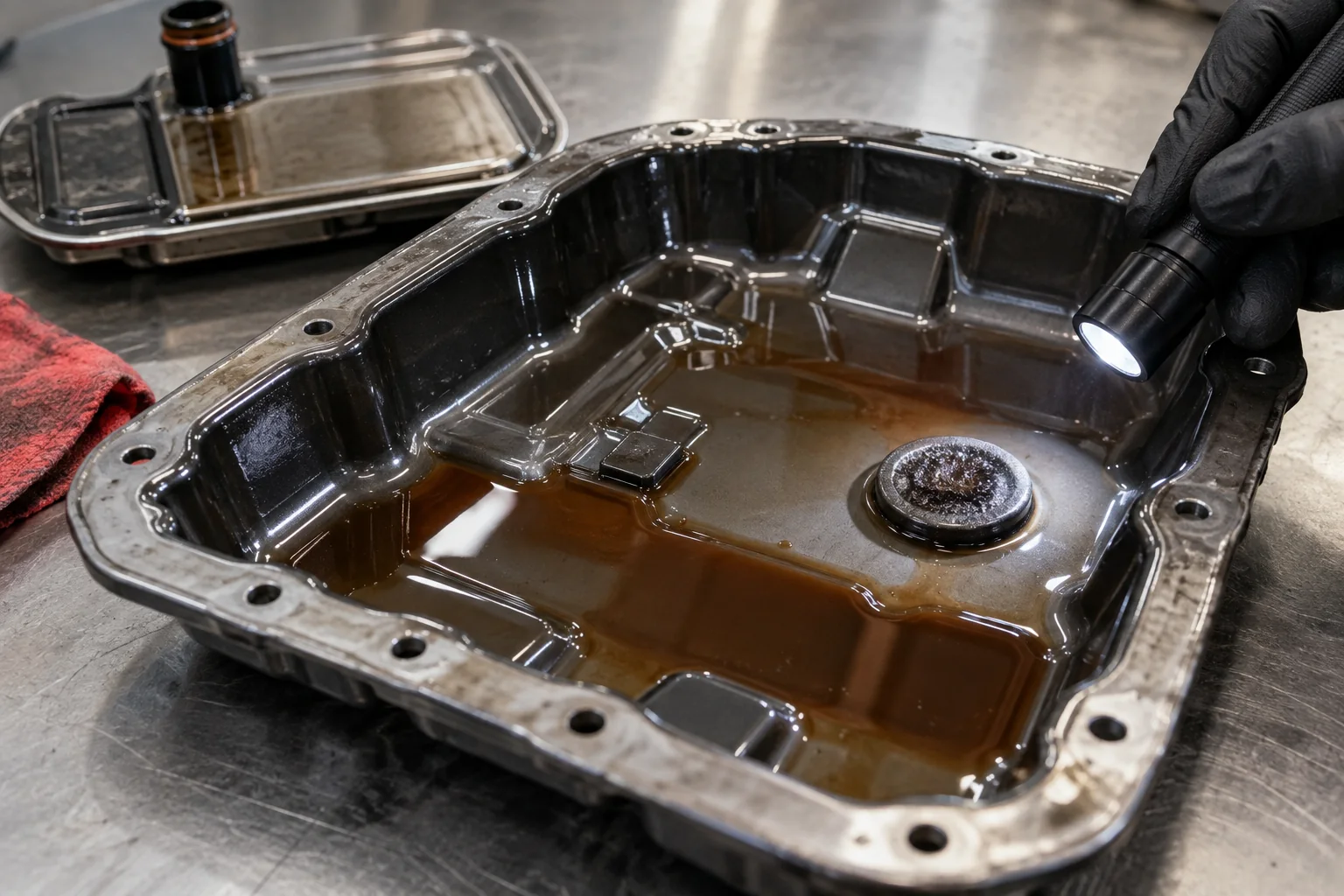
- Check fluid level using the temperature and procedure specified for the fitted transmission.
- Confirm the exact fluid approval rather than choosing by colour or a universal label.
- Locate a leak instead of relying on repeated top-ups.
- Investigate substantial debris, persistent slipping or overheating before choosing a routine service.
A fluid-related shudder is possible without failed converter hardware. For example, Honda’s bulletin for the 2013–2015 Crosstour V6 describes a particular judder associated with deteriorated fluid and an applicable software update. That model-specific case does not make flushing the cure for every car.
Fresh fluid cannot restore worn friction material. Avoid adding a shudder treatment, cleaning chemical or stop-slip product without approval for the specific transmission. A recommended service should explain its purpose, required fluid and how the original symptom will be checked afterward.
Choose the repair that matches confirmed findings
The right outcome might be a control repair, an approved fluid procedure or converter replacement. A failed converter is commonly replaced with a compatible new or professionally remanufactured unit. Specialist remanufacturing involves work on the sealed assembly, rather than a simple adjustment inside the installed gearbox.
| Confirmed finding | What the proposal should explain |
|---|---|
| Fluid or applicable calibration concern | Why the specified service or update fits this vehicle and symptom |
| Wiring, solenoid or valve-body fault | The test result and which control component needs repair |
| Converter clutch or mechanical damage | Part compatibility, removal work and the condition of the rest of the transmission |
| Debris or wider internal damage | Whether filter, cooler, pump or clutch checks extend the repair scope |
Converter replacement does not automatically mean a complete gearbox rebuild. It also does not rule out wider damage. When debris has circulated, the workshop needs to explain how the filter and cooling circuit will be assessed and what further inspection is justified. Fitting another converter while leaving a confirmed contributing fault unresolved can lead to repeat trouble.
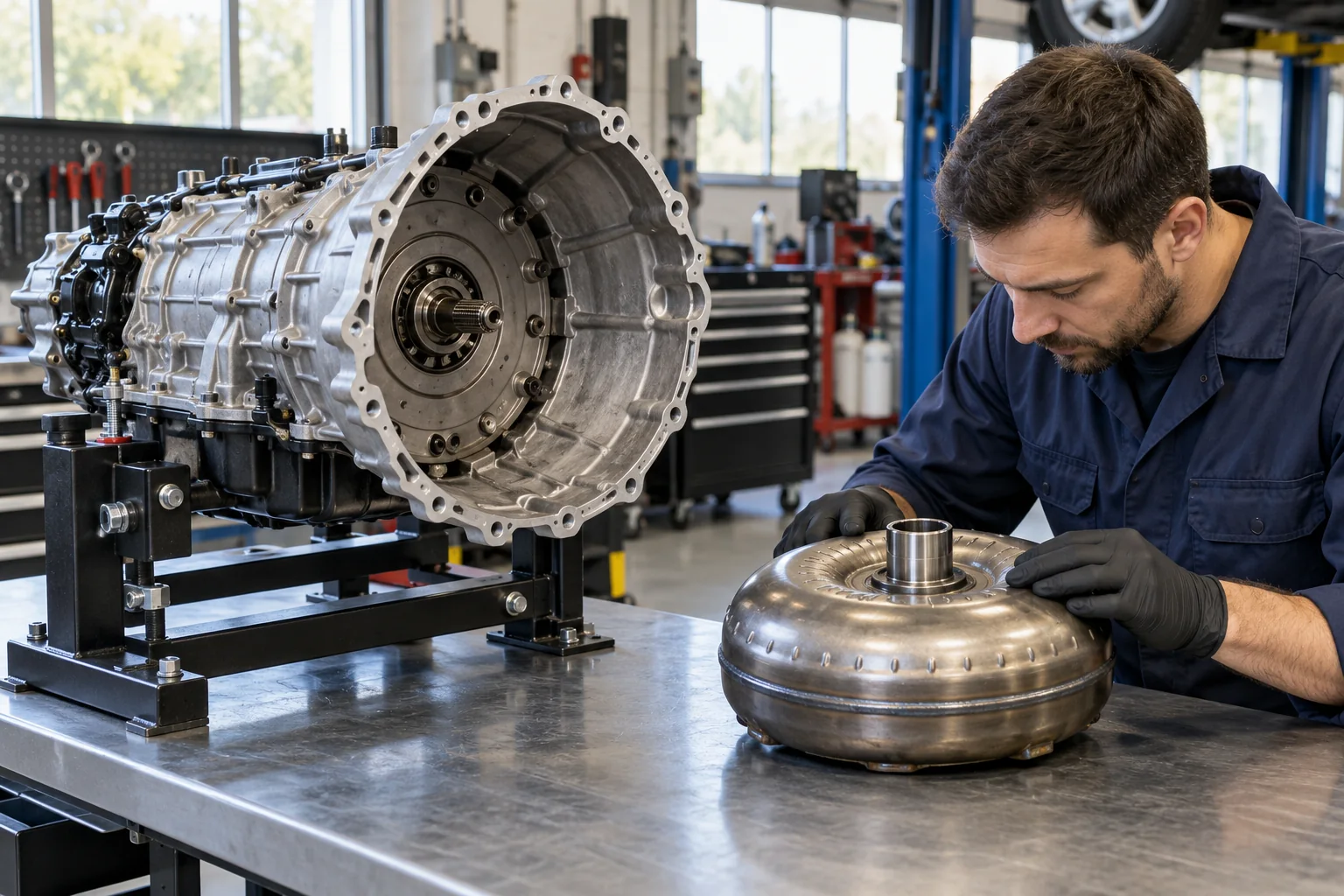
Compare the complete fitted quotation before approval
A replacement part’s price is only one part of a converter job. Access often requires transmission removal, and the final scope depends on what testing finds. An overseas dollar range or a general gearbox rebuild price cannot establish the cost for your car in Dubai.
When comparing proposals for transmission repair, ask which finding supports the work and what the total includes. Request a written AED quotation with VAT included in the total, rather than comparing a bare part with a complete fitted job.
- Identify the new, remanufactured or used part and its compatibility with the transmission code.
- Separate diagnosis and any removal or inspection charge due if further work is declined.
- Include agreed removal and refitting, specified fluid, seals and required service parts.
- State whether cooler work, additional damage, coding or relearning is included or quoted separately.
- Confirm stock, completion expectations and the written parts and labour warranty terms.
There is no single repair price or warranty period that applies to every converter. If dismantling reveals more damage, ask for the findings and a revised scope before approving extra work. The practical comparison is what each proposal will resolve, what remains uncertain and how the result will be checked.
Record useful details while avoiding extra damage
You can help the assessment without performing a mechanical test. Record the model, year, mileage, exact warning and whether the fault occurs cold, warm, during a shift or at steady speed. Mention recent fluid, engine or transmission work and whether the complaint started afterward.
- Photograph a warning only when safely parked.
- Keep service invoices and the fluid specification from recent work.
- Avoid towing loads or repeatedly provoking slipping while a fault is unresolved.
- Follow the owner’s manual for fluid maintenance and any severe-use requirements.
- Give a recovery operator the drivetrain details and whether the car can select Neutral.
A mild intermittent shudder still needs assessment, but there is no guaranteed safe distance to drive with it. If operation becomes unpredictable, stop safely. The transport method must suit the vehicle, and selecting Neutral does not make every car suitable for towing with its driven wheels on the road.
Answers to common questions about converter symptoms
What does torque converter shudder feel like?
It can feel like a rapid rumble-strip vibration on a smooth road, often under light throttle. Its link with clutch operation needs checking because engine, fluid and driveline faults can produce similar sensations.
Can P0741 confirm that the converter is bad?
It identifies a clutch performance or stuck-off concern on many vehicles. It does not provide a universal replacement instruction. The vehicle-specific fault procedure and supporting electrical, hydraulic and mechanical evidence determine the repair.
Can the converter cause stalling at a stop?
A lock-up clutch that fails to release can contribute to stalling during deceleration. Engine idle, ignition or fuel problems need distinguishing. Repeated stalling makes continued driving unreliable and warrants assistance.
Will changing the fluid stop the shudder?
It may help when the confirmed cause is fluid condition and the vehicle has an applicable service procedure. It cannot renew damaged friction material, repair a faulty control circuit or guarantee a cure for every vibration.
Can a converter problem appear without warning lights?
Yes. A symptom may need assessment even without a stored converter-specific code. Reproducible operating conditions and suitable live data can help identify the source.
Does a bad converter require a gearbox rebuild?
Not automatically. Converter damage, control faults and wider gearbox wear need separating. Debris or low pressure may justify further inspection, but the repair scope should follow the findings.
How much does converter replacement cost in Dubai?
A useful quotation needs the exact vehicle, transmission and confirmed fault. Ask for the complete fitted AED total including VAT, agreed fluid and service parts, with any additional inspection or cooler work identified.
Can I test the converter in my driveway?
You can record parked observations and warnings. Do not improvise a brake-held acceleration test, crawl under a running car or remove fluid plugs. Converter diagnosis needs vehicle-specific data and properly controlled workshop checks.
Arrange an assessment for the symptoms you notice
Tell our Al Quoz team the model, year, warning message and when the shudder, slip or stalling occurs. We can confirm model support, the initial checks and the assessment fee before booking. Mention loss of drive or overheating so we can discuss suitable assistance.